By Jimmy Siyasa
More often than not, faith and science are viewed as at odds in the postmodern age. Attempts by those who think the two can coexist are oftentimes met with a cold reception. Postmodern thinkers and scientists maintain that in the empirical world, scientific endeavour takes pre-eminence over spirituality.
Communist philosopher Karl Marx, in an 1843 publication, said “Religion is opium of the masses…,” underlying his essentially socio-economic argument of a deep-seated disdain for religious belief. Following his thesis are several other anti-God or philosophies and thinkers who were opposed to Christianity and often advocated its abolition as a prerequisite for society to advance socio-economically and intellectually.
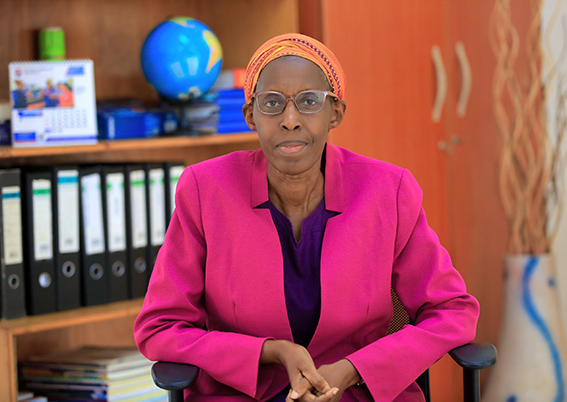
Prof. Monica Chibita, the Vice President of the Society of Christian Scholars Uganda
Today, institutions of higher learning in Uganda, America, Europe and much of the world continue to wrestle with the possibility of mastering a duality of worldviews.
Against this background, the Society of Christian Scholars Uganda (SCS-U) strives to integrate “faith with learning, teaching and research, to bring about holistic transformation in institutions, disciplines, and society.” Co-founded by some of Uganda Christian University’s (UCU) top academics and other former administrators, the Society of Christian Scholars Uganda is championing a missional, yet intellectual cause.
“When Christian scholars see their classrooms as mission fields and their research as worship, nations are transformed and God is glorified,” noted the President of SCS-U, Dr. Ernest Tashobya Katwesigye.
This is rooted in the Judeo-Christian concept that every thought, deed and all expression of an individual should glorify God. Beyond mere morality, it applies to one’s profession.
The Vice President of the society, Prof. Monica Chibita, argues that “when we fail to apply biblical lenses to our scholarship, we, by default, endorse alternative worldviews.”
Chibita, a former dean at the UCU School of Journalism, Media and Communication, added: “All knowledge comes out of a worldview, from the author’s view of what is real, to their view of what constitutes legitimate knowledge, to the things they value in the research process.”
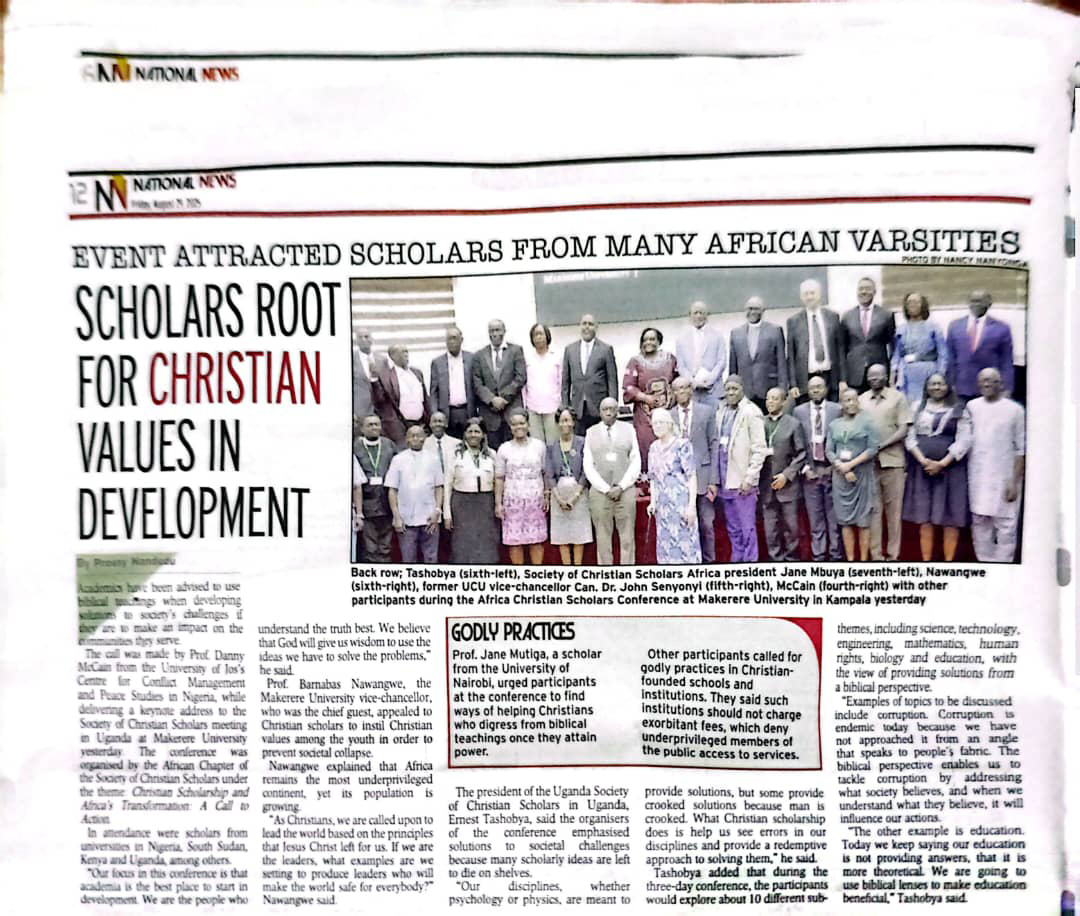
Appearing on a television interview ahead of the third SCS-U conference held in August 2025, Dr. Daniel Ruhweza, a lawyer and Senior Lecturer at Makerere University, said that “there is a push world over to desensitize our beliefs from the professional work that we do,” and yet one’s beliefs, whether Christian or otherwise, cannot, at any point, be detached from their being or doing.
SCS-U has many ideological and systemic hurdles to jump in its quest to re-center God in a heavily secularized world.
Chibita believes that Christian academics will likely shelve their biblical convictions for their work or themselves to be accommodated by their ‘open-minded colleagues’ or land a publication offer. She notes that this is partly a consequence of either intended or unintended academic lone-wolfing.
SCS-U seeks to bridge that gap by serving as a hub for Christian researchers to sharpen one another. When asked what’s in it for young Christian scholars, Chibita says: “There are few things as powerful as scholarly integrity. If young Christian scholars appreciate this, they will be more intentional in the theoretical and methodological choices they make. Their motivation will also change, and their work will feel and be more valuable.”
Inventions and discoveries by household names like Galileo Galilei, Yohanes Kepler, Isaac Newton and others were inspired by their biblical convictions and acknowledgement of God whose creations they not only marvelled at but were curious to study through scientific means.
In the final analysis, per Prof. John Lennox, an Irish Mathematician and Christian apologist, states: “God is not an alternative to science; he is not to be understood merely as a God of the gaps. He is the ground of all explanation: it is His existence which gives rise to the possibility of explanation, scientific or otherwise.”
+++++++++++++++++++++++++++++++++++++++++++++++++++++++++++++
To support UCU programs, students, activities and services, go to www.ugandapartners.org and click on the “donate” button, or contact UCU Partners Executive Director, Mark Bartels, at m.t.bartels@ugandapartners.org.
Also, follow us on X (formerly Twitter), Instagram and Facebook.
Discover more from Uganda Partners
Subscribe to get the latest posts sent to your email.