Story By Linda Ojore
(UCU School of Medicine student, sponsored by Uganda Partners)
Photos by Patty Huston-Holm and Mike Holm
I was first thinking about a career in medicine when my younger brother, Joash, was born with a heart problem. It required him to travel to Germany to get a valve implant to survive. He was seven months old, and I was age 12 – the age Joash is now as I am in year five at the Uganda Christian University (UCU) School of Medicine (SoM).
Still today, I remember my personal anxiety about raising funds and when Joash might move up on the waiting list for this life-saving procedure.
As of the summer of 2026, Joash remains healthy while I continue working toward a Bachelor of Medicine and Bachelor of Surgery.
Since becoming a UCU medical student in 2021, I have learned many aspects of health care. One of those was in year two as we studied physiology of the nervous system. This included details of the division of the nervous system – central (brain, spinal cord) and peripheral (nerves) aspects of the human body.
My curiosity has taken me on many paths in my studies. One of these was an opportunity to learn more about a disorder called Parkinson’s Disease (PD), which the World Health Organization notes is the fastest growing neurological disorder in the world. I knew that PD was surrounded by misunderstandings and misperceptions, especially in Uganda.
Patty Huston-Holm, an American journalist volunteering for the Uganda Partners NGO, asked me to accompany her as part of her journey to do research and write about PD in my country. I knew Patty as in 2024 she followed me at Mengo Hospital for more than five hours to write about “a day in the life of a medical student.” Since then – in mid-2025 – Patty, living in Ohio, shared her diagnosis with PD.
This, then, is some of what I learned about PD as I accompanied Patty as part of her learning the weekend of July 3-5, 2026.
Hannington Kabugo, co-founder of Parkinson’s Si Buko, a non-governmental organization that started in 2017, traveled with us.
As an advocate for food science on a mission to dispel myths and spread the truth about PD, Hannington shared with me how he drew this passion. During his adolescence, he watched his mother being abandoned and left to die – likely a victim of misconceptions and realities surrounding PD. I say “likely a victim” because then (almost two decades ago) his mom was undiagnosed. This fueled him to team up with a group of people in the USA, United Kingdom and Uganda to reach out to people with suspected cases of PD, extend healthcare services to them and allow them to be accepted in their communities. Hannington wants to improve their quality of life while educating those communities about the disease that is not contagious and not, as some believe, associated with witchcraft.
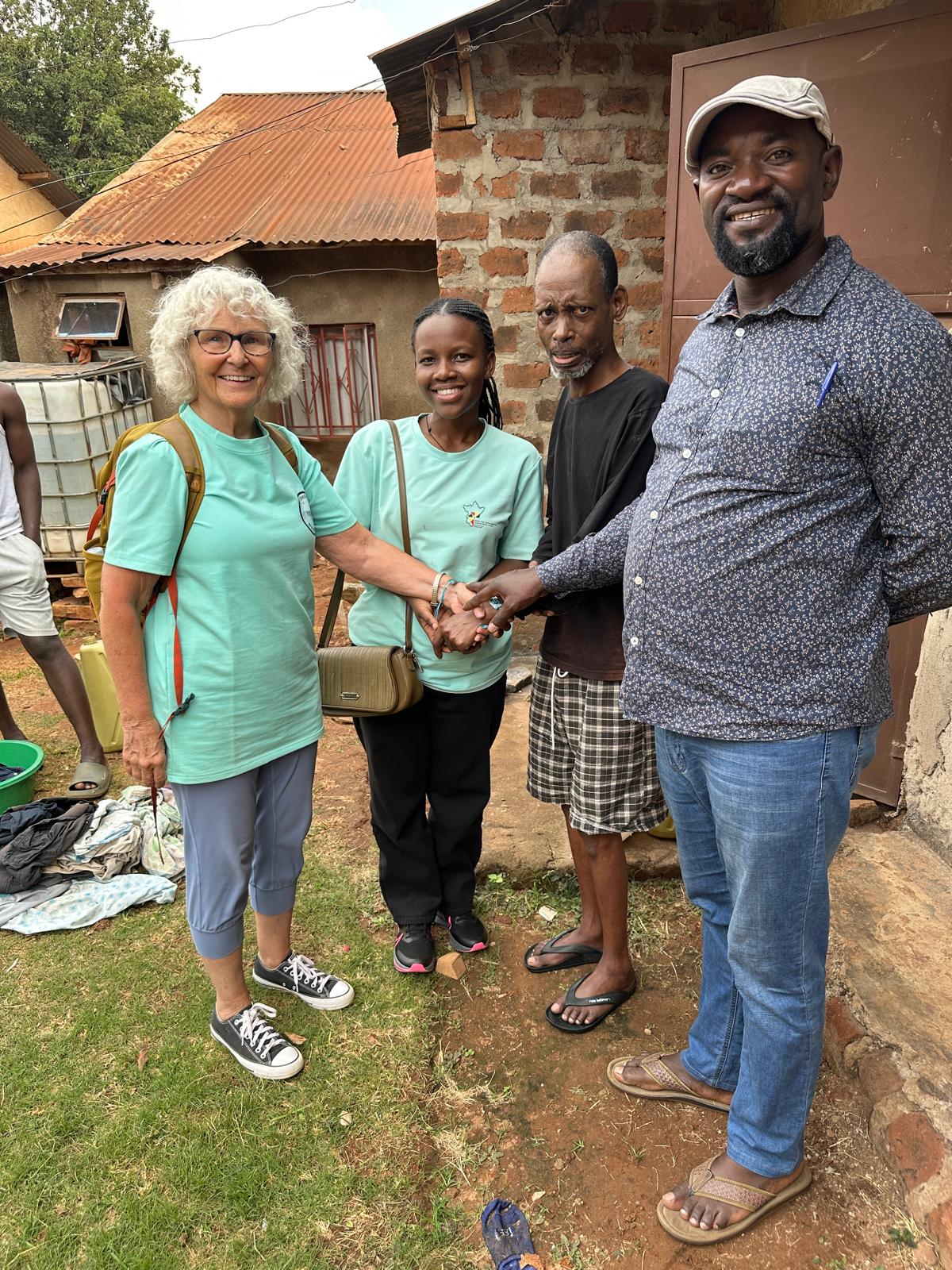
Posing outside a home in Mbuya parish, Kampala, are (left to right) Patty Huston-Holm, Linda Ojore, Patrick Byaruhanga and Hannington Kabugo.
The non-profit’s four main activities are: Follow up on people living with diagnosed or suspected PD; provide contributions for their medication, food and utilities; accompany them to medical offices or hospitals for diagnosis and treatment; and dispel myths about the disease.
I learned that carbidopa/levodopa is the primary medication used to manage symptoms of PD in developed countries. Frequently referenced by the brand name Sinemet or Cinmet in Uganda, the drug costs between 2,000-to-3,000 Ugandan shillings (under $1) per tablet. The cost and availability are barriers for most diagnosed with PD here. With this medication, I sensed the realities of what I learned in medical school – that governments often require a high threshold of officially diagnosed patients nationwide before stocking condition-specific medications in public centers. Additionally, diagnosis requires money for transport and to pay a neurologist.
To bridge this gap, Hannington informed us that one of the current projects his organization is working on involves research on a mucuna plant that is believed to harbor a certain quantity of dopamine, the central treatment in Parkinson’s Disease. With progress in this field, many people living with PD stand high chances of acquiring better health services thus improving their quality of life.
In the wee hours of the morning of Saturday, July 4, we set off to meet two patients under Parkinson Si Buko care and a plantation where the mucuna plant is grown.
Our first stop was at the mucuna plantation at the National Crops Research Institute along Zirobwe-Gayaza road. I learned that this plant of interest has been speculated to have a composition of dopamine, a neuro-transmitter in the body. John Gamusi, a researcher at the plantation, explained to us that mucuna is used as a natural fertilizer in farming because it fixes nitrogen into the soil. Also, it increases milk production in cattle.
Trials have yet to establish whether the benefits to crops and livestock are mirrored in humans.
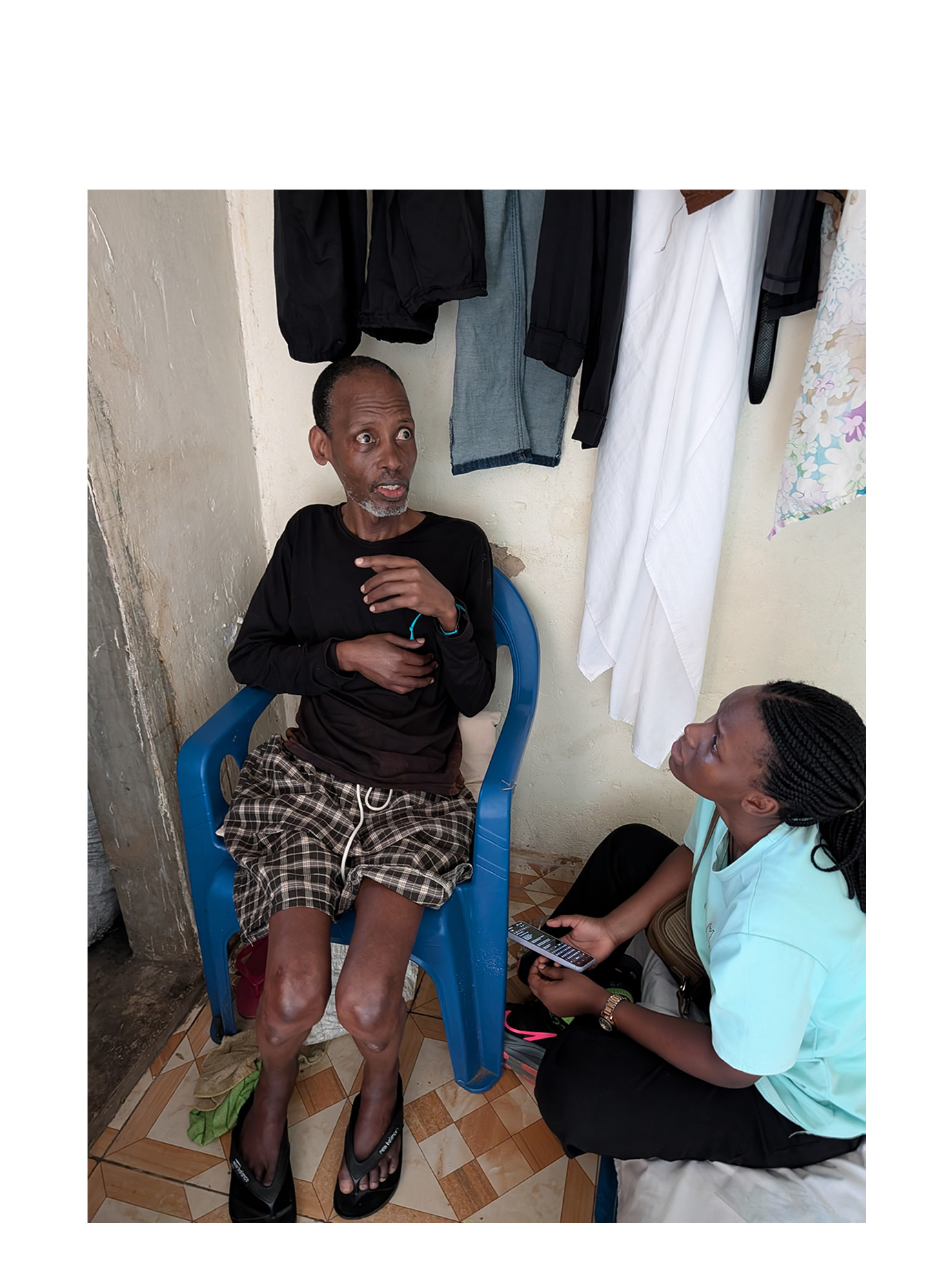
In Mbuya parish, off Gayaza road, we visited Byaruhanga Patrick, a 56-year-old man who has lived with Parkinson’s for the past 20 years. Through our interaction, I learned that he is a father of five children, but stays with a non-relative caregiver.
As Patrick shared his story, I could sense the physical and emotional burden he has carried over the years. He admitted that sometimes he fails to take his medication on time because of unavailability of food to help process it. Although he still has a good appetite, his meals depend on the servings of his caregiver.
Prior to the arrival of his current caregiver, Patrick stayed with a young male who sometimes withheld the maintenance money provided, forcing him to often sleep without food. When asked about the last time he had a medical review, he replied that it was four months ago, and he receives his anti-Parkinson medications on time, all thanks to the Parkinson’s Si Buko organization.
Listening to Patrick made me realize that even when treatment is available, limited support can make chronic disease management difficult. I was also able to appreciate how important caregivers are in the lives of people living with chronic illnesses.
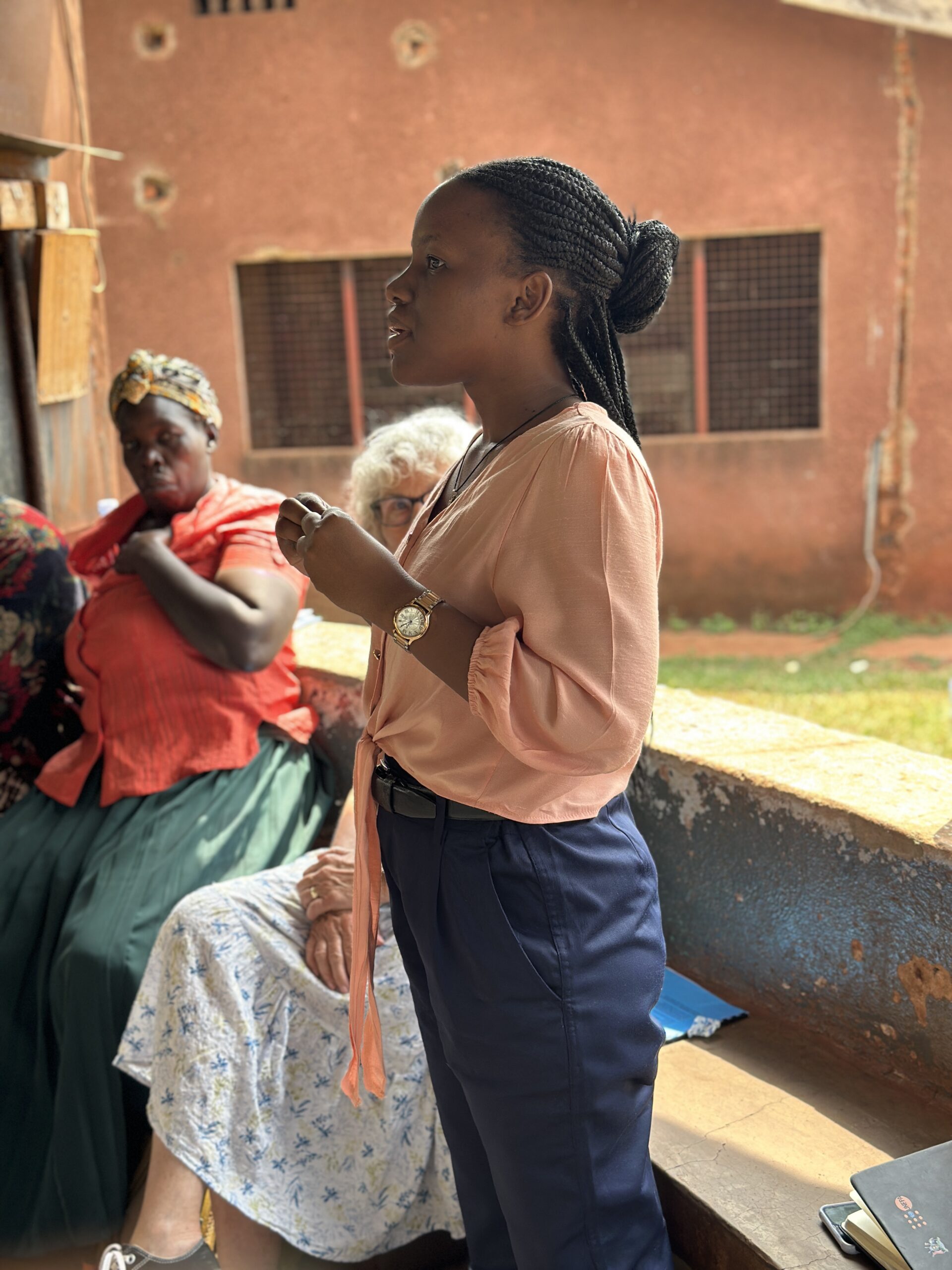
Linda Ojore, UCU School of Medicine student whose tuition is sponsored by Uganda Partners, speaks to a group of 26 health care workers in Jinja.
Along Mawanda Road in Kamwokya, a downtown slum area in Kampala, we met Nuuh Ssekabira, a 72-year-old retired electrician who has lived with severe tremors for about 10 years. Initially, he believed that he had been bewitched by his wife. He remains uncertain about the truth about his condition. He told us that he had previously used Chinese herbal medicine in the hope of getting better, but it did not help.
His story has similarities to Patrick’s. Nuuh’s 10 children don’t feel comfortable living with him in his current state. He spends most of the day alone because his caregiver, who is his wife, leaves for work early and only returns home late in the evening. During the day, he buys food from a nearby restaurant and manages as best as he can.
What saddened me most about Nuuh was learning that he has never had the opportunity to see a neurologist for proper diagnosis and treatment. Also, he faces stigma from the children in the neighborhood who nicknamed him “the shaking man.” Despite all these challenges, he is optimistic that with proper access to treatment, he will also be able to improve his quality of life. Here, I learned that access to proper health care is essential for people living with chronic illness and family support is foundational to improved quality of life.
On Sunday, July 5, my awareness of Parkinson’s Disease went deeper during a three-hour seminar organized by Parkinson Si Buko at Mpumude Health Center IV, in Buikwe district. Among 26 health care participants, only six knew anything about PD before the training.
Led by Hannington, information about how to identify PD symptoms for further verification by a neurologist was shared. In the session, I discovered that Uganda has 11 neurologists, of whom only two are actively diagnosing PD. While research claims Parkinson’s is the second most common neurodegenerative disorder globally, ranking just behind Alzheimer’s disease, inadequate access to specialist care in Uganda reflects a likely portion of undiagnosed cases.
As the seminar drew to a conclusion, Patty shared her journey with being diagnosed and living with Parkinson’s Disease.
“Having a sense of purpose is important,” she said, adding, “Beyond that, the most important thing is to know you are loved, regardless of your condition.”
She told the group that even in Ohio, USA, where she lives, there are misperceptions about the disease – including that PD symptoms and realities are different for each diagnosed person. While body tremors are the most common symptom, for example, not all PD diagnosed persons have those.
As I reflected on the weekend activities, I realized that treating Parkinson’s Disease is about much more than prescribing medicines. Patients require regular follow-up, good nutrition, emotional support, committed caregivers and advocates and access to specialized healthcare. More importantly, they need people who will listen to them, respect them and understand what they go through every day.
This opportunity doesn’t mean I will become a specialist in neurological disorders, but has paved the way for me to keep asking questions and seeking answers in all areas of the continually expanding health care industry.
++++
To support UCU programs, students, activities and services, go to www.ugandapartners.org and click on the “donate” button, or contact UCU Partners Executive Director, Mark Bartels, at m.t.bartels@ugandapartners.org.
Also, follow us on X (formerly Twitter), Instagram and Facebook.
Discover more from Uganda Partners
Subscribe to get the latest posts sent to your email.