By William Opio
In 2008 when Dianah Aharimpisya went to Uganda Christian University (UCU) to apply for undergraduate studies, she knew what she wanted to study: gender studies. She had hoped that with a degree in gender studies, she would be fully equipped to contribute to the movement of fostering the rights of women.
However, that is not the course she finally pursued at undergraduate level.
A conversation with people at the university’s admissions office changed Aharimpisya’s mind from gender studies, which was considered a narrower course, to social work and social administration, which could equip her with the skills to be able to champion the rights of different vulnerable groups. That conversation made her understand the key tenets in the different courses and for what philosophy each stood.
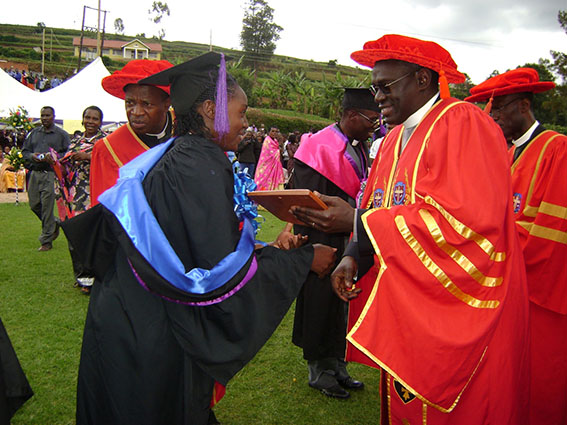
Dianah Aharimpisya receiving a plaque from former Vice Chancellor John Senyonyi after she attained a First Class degree at UCU.
Aharimpisya was raised by a single mother, a tag many people in society frowned upon. She says it is for that reason that she had her eyes set on a course in gender studies, so she is professionally equipped to advocate the rights of women in society.
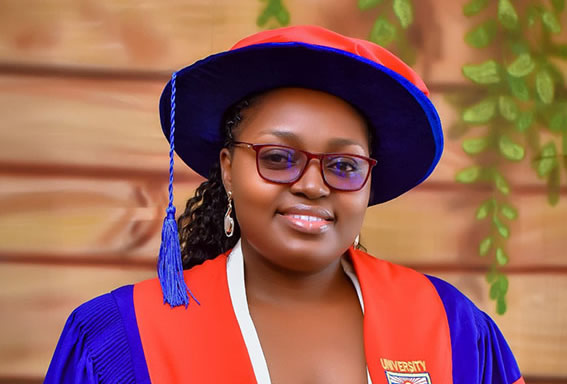
To date, Aharimpisya is a champion of the rights of vulnerable groups. And that was the basis of her recent PhD research on elderly protection, gerontological mechanism and welfare status in Uganda. She was among the students who graduated at Nkumba University in October 2025.
When asked what motivated her to conduct research in the field, Aharimpisya listed three reasons: the high level of vulnerability of older persons in Uganda, the few mechanisms that help to protect their welfare and the need for physical, emotional and socio-economic protection.
As such, she came up with a model to ensure elderly protection and welfare status. The Sustainable Humane Elderly Co-Existence Model is a framework that promotes dignity, justice, intergenerational co-existence and responsible care for older persons.
The model emphasizes human interaction, stewardship and inclusion, while actively involving older persons themselves in shaping solutions. According to Aharimpisya, it also offers practical, sustainable strategies for addressing elder abuse and improving the welfare of older persons in Uganda.
She considers her doctorate research as a contribution to development of a relevant national policy that can impact lives through improved protection, dignity and inclusion of older persons.
And she now has a dream: establishing an elderly home, while cognizant of the fact that family-based care systems are changing due to urbanization and migration. She believes older persons deserve safe, respectful and supportive environments where they can live with dignity.
At UCU, Aharimpisya found not just academic training, but a strong spiritual foundation. She said the Christian environment nurtured her faith, while the leadership opportunities stretched her capacity. She served as a leader in charge of religious affairs, Guild General Secretary, and Chapel Warden, roles she said helped her grow into a confident and compassionate leader.
She speaks with gratitude about the influence of the late Rev. Canon Dr. Stanley Katungwensi, Prof. Firimooni Banugire, the late Prof. Joy Kyamunyogonya, and other committed lecturers who she says shaped her academic discipline and ethical grounding.
Graduating with a First Class degree at UCU, she said, gave her the confidence to pursue higher education. Through UCU–Bishop Barham University College, she received the Prof. Joy Kyamunyogonya Scholarship, awarded by Dr. Mary McCarthy. This opportunity enabled her to pursue a Masters of Social Work and opened doors for professional growth and leadership.
Aharimpisya currently serves as a lecturer at Makerere and Nkumba universities in Uganda. In the course of her duties, she said she mentors students to see education not just as a pathway to employment, but as a tool for social transformation.
Her influence extends beyond the classroom. As a consultant with Uganda’s Ministry of Gender, Labor and Social Development, she has contributed to the review of the National Policy for Older Persons and for equal opportunities. She also serves on the National Coordination Committee for Older Persons, helping to guide national efforts on ageing and social protection.
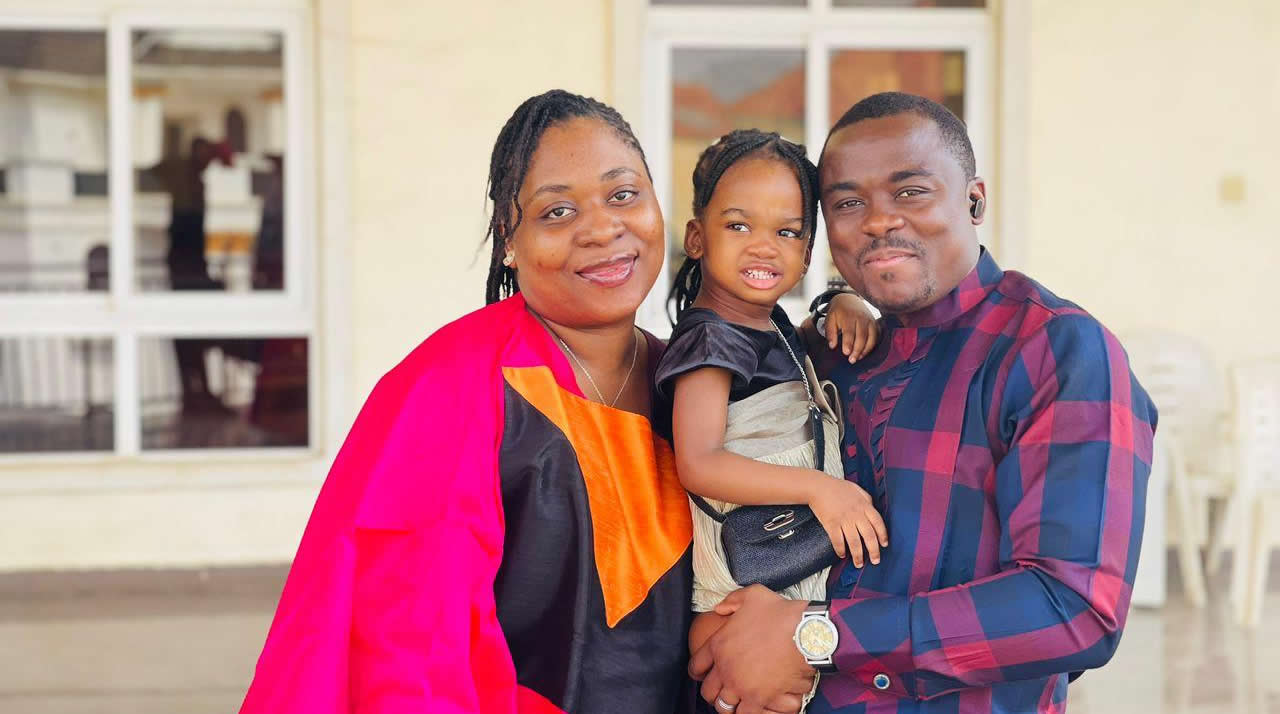
Aharimpisya is married to Daniel Irankunda, whom she describes as her biggest supporter and cheerleader. Together, they are raising four children – one girl and three boys. Balancing family life with academic and professional demands has not been easy, but she says it has strengthened her resilience. Through time management and discipline, she has learned how to pursue excellence while remaining present for her family.
++++++++++++++++++++++++++++++++++++++++++++++++++
To support UCU programs, students, activities and services, go to www.ugandapartners.org and click on the “donate” button, or contact UCU Partners Executive Director, Mark Bartels, at m.t.bartels@ugandapartners.org.
Also, follow us on X (formerly Twitter), Instagram and Facebook.
Discover more from Uganda Partners
Subscribe to get the latest posts sent to your email.