By Prisca Adaeze Nenger
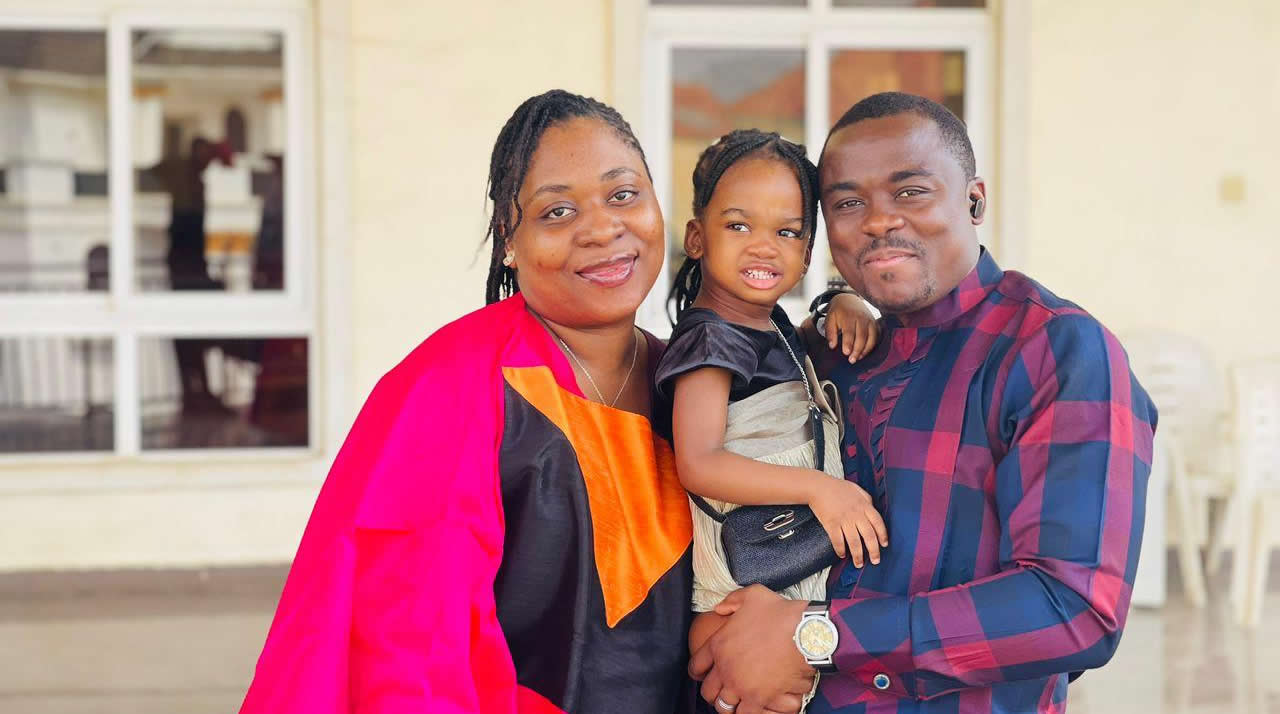
All the way from Nigeria to Uganda, Stephen Daniel, popularly known as ‘Dr. Progress’ and Ayebatogu Ayebatonye Oruwori arrived at Uganda Christian University (UCU) as international students seeking academic growth and new experiences. Both firstborns from Christian families, they were raised with strong biblical values that shaped their character from an early age. This upbringing taught them to lead with faith, integrity, discipline, and responsibility, while giving them a deep sense of purpose and respect for others. What began as a simple on-campus friendship between Stephen and Ayebatogu gradually blossomed into a love story that would shape the course of their lives. Years after graduating, that friendship and courtship matured into marriage and have since grown into a family of three with the arrival of their daughter, ADAYA. Stephen earned two degrees from UCU: a Bachelor’s Degree in Development Studies in 2016 and a Master’s Degree in Research and Public Policy in 2019, while Ayebatogu Ayebatonye Daniel graduated with a Bachelor of Laws (LLB) in 2017 before proceeding to the Nigerian Law School in Abuja, where she obtained her Barrister-at-Law (B.L) qualification in 2018. She later continued her academic journey at the University of Groningen in the Netherlands, earning a Master of Laws (LLM) in International Commercial Law in 2022. Come with me as we take a ride on their journey at UCU!
Early Life & Background
How did your childhood experiences influence your educational and career ambitions?
Ayebatogu: I was raised in a home where service, integrity, and commitment to principles greater than oneself were lived values, and watching my parents’ journey in ministry showed me that meaningful impact comes through dedication, excellence, and mastery of one’s work. That foundation drew me to law as a profession centered on protecting the vulnerable and promoting fairness. Their emphasis on responsibility shaped the seriousness with which I approached legal training, while being the firstborn instilled the capacity to carry weighty responsibility. My career in competition and consumer protection law reflects these influences, as I work to uphold fair market practices and defend consumer rights with discipline, integrity, and respect for the rule of law.
Stephen: Growing up, my ambitions evolved quite a bit, which I think is natural for any child who is curious about the world. At different points, I wanted to be a pilot, then an entrepreneur. I remember once hearing the story of a young child who died because her family could not raise the money to fly her abroad for a life-saving heart or kidney transplant. That story deeply affected me. I cried and boldly declared that I would become a doctor so I could save lives. However, I quickly realised that while the desire to help was genuine, I was not cut out for medical school — the sight of blood alone was enough to make me emotional.
What never changed, though, was the underlying motivation behind all those ambitions: I have always wanted to serve people and contribute meaningfully to society. From a young age, I was deeply aware of the gaps around me and the injustice of preventable suffering, especially on the African continent. Over time, that awareness matured into a clear conviction that my work must, in some way, contribute to Africa’s development and transformation.
Those childhood experiences shaped my educational and career path by pushing me away from titles and professions as ends in themselves, and toward purpose. They helped me realise that impact can be achieved through many routes, and that my calling lies in using ideas, policy, leadership, and service to help build systems that work for people and move Africa closer to its full potential.
Journey to UCU

A throwback picture of Stephen Daniel and Ayebatogu Oruwori as undergraduates at UCU
What inspired you to choose UCU for your studies?
Ayebatogu: It was not so much a deliberate selection as it was a confluence of conviction and divine providence. After completing secondary school, I sat for the Joint Admissions and Matriculation Board (JAMB) exam (Nigeria’s major university entrance examination) twice. The first attempt resulted in a cancellation; the second offered me admission to study International Relations at a top private university in Nigeria. However, when my father asked me pointedly, “What do you want to study – law or international relations?” my answer was immediate and certain: law. Rather than settling for what was available, he encouraged me to wait and trust that God would open the right door. That counsel proved decisive. Shortly thereafter, my father attended a GAFCON program alongside other Anglican bishops, during which he visited UCU. He returned home with UCU’s brochure, shared it with me, and prayerfully guided me to apply. The opportunity aligned perfectly with my conviction about studying law, and UCU’s LLB program admitted me.
Stephen: My decision came at a point of waiting and uncertainty in my life. By that time, I had spent close to five years at home without securing admission into a Nigerian university because I refused to pay a bribe. During that period, my father was working in Uganda and suggested that I come over to work with him. I declined, not out of stubbornness, but because I knew deep down that I still wanted to pursue my education.
Instead, I began looking into universities in Uganda, and that search led me to UCU. There was no long, elaborate plan behind it. I found the institution, felt a quiet sense of peace about it, and applied on the very last day applications were open. In many ways, it felt like a step taken in faith rather than certainty.
Looking back, that decision marked a turning point. What began as a last-minute application became the foundation for a formative season of my life. The rest, as they often say, is history — one that I can only attribute to God’s guidance and timing.
Life as Students at UCU
What was your favorite part of being a student at UCU, academically, socially, or spiritually?
Ayebatogu: My favorite part, especially spiritually and socially, was the sense of family and belonging I experienced through the Senyonyi family. Rev. Can. Dr. John and Canon Dr. Mrs. Ruth Senyonyi, together with their children and extended family members (the Aunties, Uncles, their Children, their parents), literally received my sister and me as their own, providing a level of holistic support that went far beyond what we could have imagined. Because of them, it was difficult to feel homesick; we were not just cared for, we were parented, mentored, and consistently guided in the right path, we were even given Luganda names (Nambusi and Nakyeyune). That combination of spiritual covering, emotional support, and practical care created a safe, nurturing environment in which I could grow in my faith, character, and confidence. It remains one of the most defining and cherished aspects of my UCU experience.
Stephen: What I enjoyed most was the warmth of the people and the strong sense of community that ran through campus life. There was an intentionality about how people related with one another that made the environment feel welcoming and supportive. The community worship hours we had twice every week stood out for me. Those moments created space to pause, reflect, and engage beyond academics, and they helped shape a shared campus identity.
Spiritually, the Survivor Fellowship played a significant role in my growth. It was more than a fellowship; it was a place of accountability, leadership development, and service. Over time, I had the privilege of serving as “Papa” of the fellowship, while my wife served as Treasurer, which deepened our sense of responsibility and commitment to community life.
Academically and in terms of leadership development, the Honors College leadership program stretched me in meaningful ways, sharpening my thinking and exposing me to structured leadership training. I also found purpose in leading the Nigerian Student Association, which allowed me to serve fellow students, represent our community, and build bridges across cultures. Altogether, those experiences made my time at UCU rich, formative, and deeply memorable.
What was daily life like on campus for you as international students from Nigeria?
Ayebatogu: It was a blend of structure, community, and gradual cultural integration. Academically, my days were anchored by lectures, time in the library, and group discussions that challenged me to think critically and adapt to a different academic style. I quickly learned to manage my time carefully so I could keep up with the demands of the LLB program. Socially and spiritually, campus life was enriched by the relationships I built. Interactions with fellow students both Ugandan and other internationals through chapel, fellowship meetings, and informal gatherings helped us feel part of a wider community. Daily life, therefore, was not just about studying law; it was about growing in faith, building cross-cultural friendships, and learning to navigate a new environment with confidence.
Stephen: For me, it was structured but full. Most days revolved around classes and group discussions, which required discipline and good time management. Outside the classroom, there was always something happening — fellowship hours, Bible study sessions, music rehearsals, meetings, and student activities that kept campus life vibrant.
There were also moments of travel, whether for leadership responsibilities, fellowship engagements, or simply connecting with people beyond campus. That balance between academics, faith, service, and community made daily life engaging and meaningful. It was a season of learning how to manage responsibilities while staying grounded spiritually and socially.
Challenges, Adaptation & Lessons Learned
What particular challenges did you face studying far away from home, and how did you overcome them?
Ayebatogu: Studying far away from home presented challenges that could have been quite significant, but I was blessed with preparation and support that made the experience largely seamless. From my early years in senior secondary school, I had been in a boarding environment, so the transition to studying abroad was not as jarring as it might have been for someone leaving home for the first time. More importantly, God blessed me with a loving and supportive family who stood by me throughout my time at UCU. Beyond family, I was embraced by a wonderful community at the university, such as the Nigerian Student Association, which provided cultural continuity and peer support, the International Student Association connected me with students from across the continent facing similar transitions, and the Survivor Fellowship offered spiritual grounding and accountability. My classmates also became a source of encouragement and collaboration, both academically and personally. The combination of prior exposure to independent living, a strong support network, and the deliberate cultivation of community made the challenges of studying far from home barely noticeable. I learned early that distance from home need not mean isolation; rather, it is an opportunity to build meaningful relationships.
Stephen: I was so used to being away from family even before university, and can easily adapt anywhere I find myself.
Did you experience any culture shock in Uganda? How did you adjust?
Ayebatogu: Yes, one of the first things I noticed was the difference in social interaction and communication style. As a Nigerian, I was used to being expressive, direct, and confident, often engaging in debates and using humor or sarcasm freely. In Uganda, people tend to be softer-spoken, more reserved, and value indirect communication and a calm tone. At first, I was occasionally told I was “too forward” or “too loud” or “rude,” which felt surprising, but I gradually adjusted by observing and adopting a more measured and polite communication style while still staying true to myself.
Food was another area where I experienced culture shock. In Nigeria, I am accustomed to bold, spicy, and highly flavorful dishes. In Uganda, the food is generally milder, with less emphasis on spiciness, and it is common to have a variety of food items on one plate. Initially, I missed the heat and intensity of Nigerian meals, but I learned to appreciate the diversity and balance of Ugandan dishes, and it became an enjoyable aspect of experiencing a new culture.
Language and accent differences also posed a challenge at first. While English is widely spoken in both countries, I occasionally struggled to understand certain Ugandan accents, and some people found my Nigerian accent unfamiliar too. Over time, regular interaction and active listening helped me adapt, and it became an opportunity to improve my cross-cultural communication skills.
Religion and spiritual expression were also different from what I was used to. In Nigeria, praise and worship are often vibrant, energetic, and intense, with passionate prayer sessions. In Uganda, worship tends to be calmer, giving a Hillsong-like vibe. Adjusting to this more subdued style of spiritual expression allowed me to experience worship in a different, yet meaningful, way, and I came to appreciate the beauty in both approaches.
Stephen: Yes, and food was probably the first and most obvious one. Coming from Nigeria, where meals are typically spicy, I found the food much milder than what I was used to. Very quickly, we learned to buy pepper to go with our meals, and at some point, we even made special requests, which the University graciously approved, allowing us to have special meals occasionally at the dining hall. That flexibility made the adjustment much easier and showed a real level of care for international students.
Prayer was another area of culture shock. In Nigeria, prayer is often loud, expressive, and very participatory. At UCU, when prayer points were raised, people were often quiet and reflective, which was very different from what I was used to. At first, it felt unusual, but over time I adjusted and learned to appreciate that quieter style of praying. Interestingly, it has stayed with me – even back in Nigeria now, I am comfortable with and sometimes prefer that more reflective approach to prayer.
Overall, adjusting was a process of learning, observing, and embracing differences, and those experiences broadened my perspective and deepened my appreciation for cultural diversity.
Your Love Story: Meeting, Connection & Marriage
How did the two of you first meet at UCU?
The Daniels: We first met at Venerable Dr. Tunde Yusuf house, where new and returning Nigerians gathered for what was essentially a familiarization and onboarding session into life at UCU and in Uganda generally. Uncle Tunde (as we fondly call him) is a very dear mentor to us – someone who later went on to conduct our marriage counseling. Interestingly, at that very first meeting, he looked at us and said, quite confidently (prophetically), that we would end up marrying each other. My wife immediately and loudly responded, “Never!” which is something we still laugh about often today.
How was your experience courting while studying at UCU? Were there any challenges, distractions, etc., and how did you cope?
Ayebatogu: Our courtship was very open and intentional, largely because we wanted to remain very accountable. That openness helped us keep clear boundaries and priorities. Early on, I noticed a dip in my academic performance during my first semester – nothing alarming, but enough to prompt self-reflection. I quickly realized the need to realign my priorities, and while the relationship mattered, my academics had to come first. I was very clear and vocal that if at any point the relationship became a distraction, I was willing to pause it to stay focused on my studies. I applied the same discipline to other commitments as well. I was careful not to overextend myself through student associations or even fellowship responsibilities, choosing only what aligned with my academic goals.
Stephen: From the very beginning, I was intentional about our relationship. I did not approach it casually. In fact, I did not ask her, “Will you date me?” I went straight to the point and asked, “Will you marry me?” She laughed at the time, but for me, it was important to be clear about my intentions, especially because one of my expectations going to UCU was to find a life partner.
It was later, during a trip I took to Costa Rica, that things became more serious. While I was away, I called her back in Uganda, and that period marked the point where she began to pray intentionally about the relationship. It took about 4 months or so before a reply came. From then on, our courtship became more deliberate and prayerful.
Of course, there were distractions. As students, we spent a lot of time together, and balancing academics, leadership responsibilities, and a relationship required discipline. From the outset, we agreed on clear boundaries. I was very clear with her that if I ever pressured her to cross those boundaries, she should not accept it. We were committed to honoring God in our relationship, and by God’s grace, we stayed accountable and focused. That intentionality helped us grow without losing sight of our purpose.
How has your marital journey evolved so far?
The Daniels: With Jesus Joy, we have been married for 3 years. Our journey has been deeply enriching as we consciously place Christ at the center of our marriage. It is a journey of learning, relearning, and unlearning – of making healthy compromises and intentionally building each other up in the way God has called us to support one another. We are blessed with a beautiful daughter, Adaya, now 2 years old, and we are grateful that God is guiding us as we steward her life according to His ways.
So, beyond coming to Uganda for their studies, Stephen and Ayebatogu, now a couple, not only found friendship on campus, but they also built on the godly foundation laid by their parents and drew on their upbringing and life experiences to build their own home.
To Be Continued in Part Two…
Be sure to check back for the second part of the Daniels’ story, where they reflect on their lives after UCU and share the lasting lessons, values, and experiences they brought back to their home country, Nigeria.
++++
To support UCU programs, students, activities and services, go to www.ugandapartners.org and click on the “donate” button, or contact UCU Partners Executive Director, Mark Bartels, at m.t.bartels@ugandapartners.org.
Also, follow us on X (formerly Twitter), Instagram and Facebook.
Discover more from Uganda Partners
Subscribe to get the latest posts sent to your email.