By Jimmy Siyasa
There are many “wrongdoings” that have been heaped on the media when issues of migration get to the discussion table: Failure to point out the root causes of migration, “biased” framing of the news and, sometimes, lopsided coverage or low interest in migration-related news, until there is a catastrophe.
It is issues like these that gave birth in 2023 to the Communicating Migration and Mobility, E-Learning Programs and Newsroom Applications for Sub-Saharan Africa (COMMPASS) project. The venture, funded by the European Union’s Erasmus+, sought to strengthen journalism education and improve the quality of migration reporting across sub-Saharan Africa.
After three years of COMMPASS, the project has come to an end, with some successes: about 2,300 students and journalists have benefited from the Massive Open Online Course (MOOC), which has been implemented at 37 universities in 29 African countries. Over 100 lecturers and scientists from the project’s partner and associated partner universities got trained on migration-related issues, as well as how to use the distance learning platform.
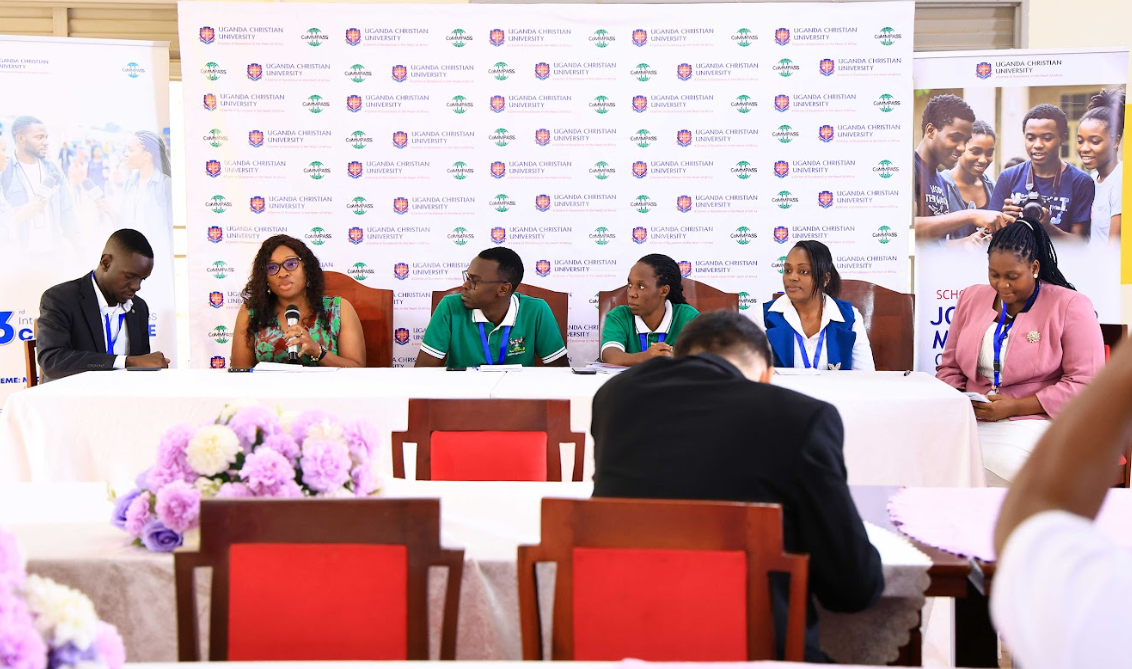
At the final project conference held in February at the Uganda Christian University (UCU) main campus in Mukono, under the theme: “Media, Migration and Mobility: Reimagining the African Narrative,” African journalists and journalism students were urged to put into practice what they had learned in the project, in addition to implementing ethical reporting that is Afro-centric and focuses on storytelling.
Prof. Ralph A. Akinfeleye, a media scholar from the University of Lagos, Nigeria said migration reporting is often least prioritized in favor of audience-puller controversies like politics, corruption and fraud.
He, therefore, urged media practitioners during a keynote address he delivered at the conference at UCU, to “go beyond the inverted pyramid formula in reporting migration in Africa and seek depth, analysis and cultural context, and to focus more on people rather than the statistics. By mid-2025, the United Nations estimated 42.5 million refugees worldwide and over 117 million forcibly displaced people globally.
The project involved six African universities: UCU and Makerere in Uganda, Malawi’s University of Livingstonia and University of Business and Applied Sciences and Burkina Faso’s Université Joseph Ki-Zerbo and Université Thomas Sankara.
Some of the students who undertook the course reported significant enhancement in their knowledge about migration-related issues and growth in their capacity to accurately report on the subject matter.
“The course increased my knowledge about migration, which I used to think was only limited to refugees,” said Chissono Semani, a journalism student at the University of Livingstonia, Malawi.
Bill Dan Borodi, a journalism graduate and staff writer at the UCU Standard newsroom, says the MOOC enhanced both his knowledge and capacity to cover the subject. “Many issues on refugees and migration go unreported, and this course was as an eye-opener. It was enriching and [journalistically] nourishing as far as Africa is concerned,” he said.
For Anthony Kizza, a journalism student from Makerere University, the course triggered his empathy in journalism. He said it acquainted him with the reality of many who have been displaced by internal strife in their countries.
The UCU Vice Chancellor, Prof. Aaron Mushengyezi, while addressing the conference, called on journalists to uphold the human dignity of people affected by forced migration.
“Migration is often intertwined with the pain of people,” he said.
“When you look at the world right now, forced migration is a serious reality. How we perceive this reality as journalists and journalism educators is very important,” Mushengyezi noted, emphasizing accurate and empathetic reporting of migration-related issues.
+++++++++++++++++++++++++++
To support UCU programs, students, activities and services, go to www.ugandapartners.org
and click on the “donate” button, or contact UCU Partners Executive Director, Mark Bartels,
at m.t.bartels@ugandapartners.org
Also, follow us on X (formerly Twitter), Instagram and Facebook.
Discover more from Uganda Partners
Subscribe to get the latest posts sent to your email.