By Patty Huston-Holm
In the past 17 years, Sarah Igambi Nakayima Walamaku has taught me a thing or two about survival, resilience and hope.
I thought of this in 2026 as we sat side-by-side and talked in the back seat of a vehicle making its way in the dust, dodging and allowing passage of motorcycles and sometimes traveling in and out of ruts from Mukono to Luwero, Uganda. Both municipalities are considered central in the country. Mukono is roughly 13 miles east of Kampala. Luwero is 47 miles north of the country’s capital city.
Uncontrolled, heavy traffic belies map distance and time of travel as trucks, cars, bicycles and boda bodas/motor bikes turn intended single lanes each way into as many as six. Our conversation en route was three hours long.
Mukono is where Sarah and I first met. She was 19, and I was 57. It was late January 2009 – my first trip to her country that initial research told me I would find zebras and giraffes roaming freely in national parks as well as coffee, tea and sugarcane plantations dotting landscapes along the road.
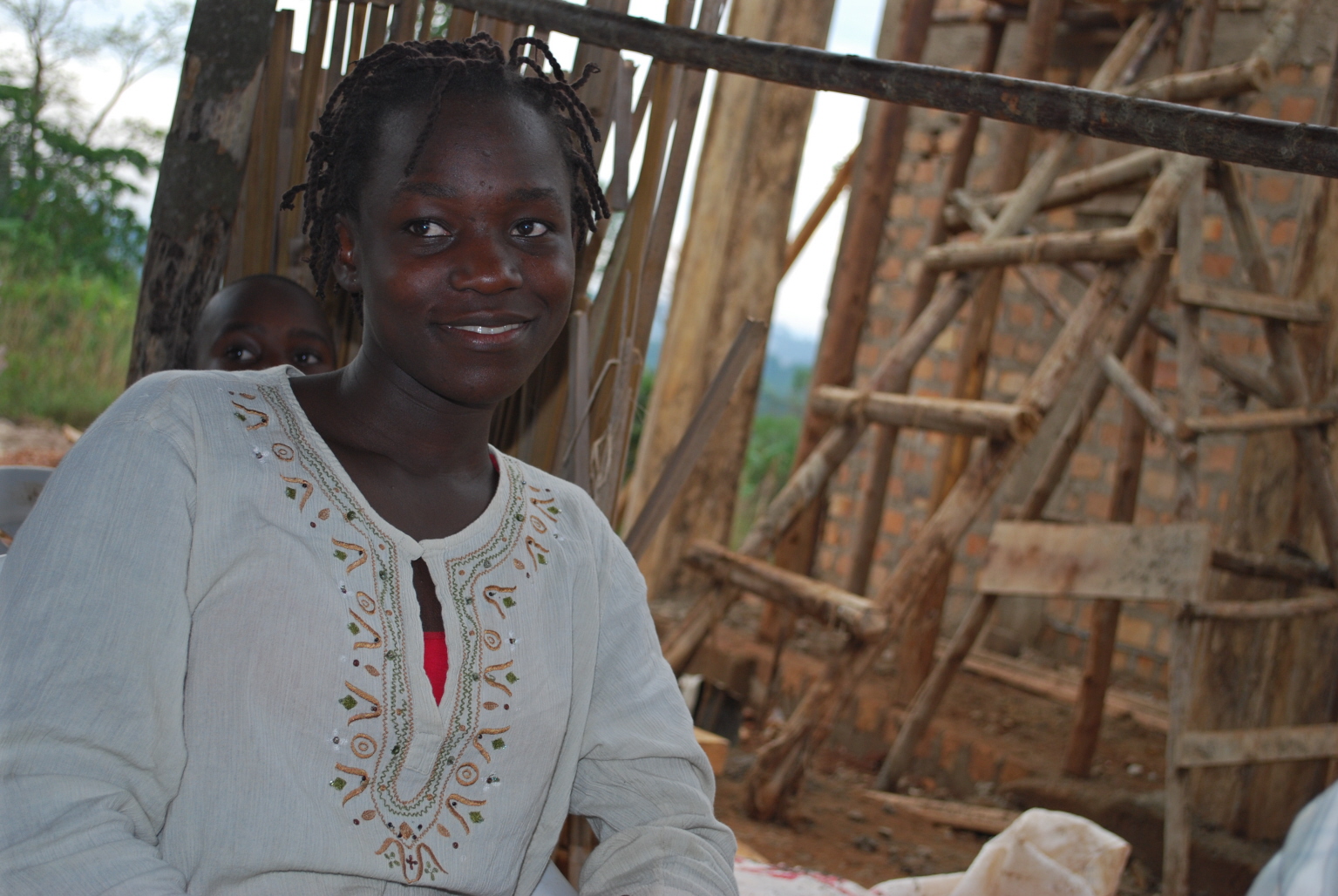
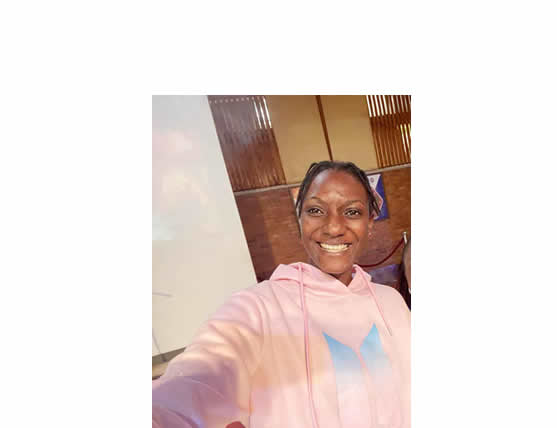
Sarah in 2009 – the year she met her UCU sponsor from Ohio, USA.
During the three weeks prior to returning to Ohio, I saw fields of these crops en route to and from eastern Uganda’s Busia at the Kenya border as well as African wildlife at Murchison Falls National Park in the northwest.
But most memorable was Sarah, a slender teenager with a radiant smile, assisting Ohio and Pennsylvania missionaries and Ugandans with church construction and teaching the art of tailoring. I watched her carry heavy boards and hand them up to workers in one location and, several miles away in a building, move seamlessly among older women, patiently guiding them on the use of newly donated sewing machines she had only just mastered herself.
By the time I flew home to Ohio from the “Pearl of Africa,” Sarah had shattered my narrow biases that relegated Ugandan women’s roles to cooking, cleaning and birthing.
I have had similar scenarios among more than a dozen young men and women now in their 30s with most of them graduates of Uganda Christian University (UCU) and supported by me through the Uganda Christian University Partners NGO. I choose Sarah, now age 36 and one of two Ugandans with that name who call me “Mom,” for this reflection because she was the first.
We spoke almost privately, while traveling to Luwero with my husband, Mike, outside of conversation earshot while seated up front next to the driver and by an open window.
Sarah shared that Luwero is best known as the birthplace of the five-year (1981-1986) guerrilla war led by the National Resistance Army and Uganda’s current president, Yoweri Museveni. Locals know it today as a common stopover en route to South Sudan and for its succulent pineapple that we purchased before the three-hour drive back on this late June 2026 day.
It is even lesser-known for our trip’s main purpose of visiting a rural school called Luwero/Nakaseke (Seal of Chris High School) and, on this day, its 100 students. Sarah was hired here as a teacher in February and then quickly promoted to head teacher. This day, June 24, 2026, is her last day.
“Mama, nobody is getting paid,” she told me weeks prior to our shared visit and again when we arrived. “I have myself and a family to support.”
Survival and resilience.
According to the Uganda Economic Policy Research Center, 12% to 13% of university graduates have jobs immediately after receiving a degree. Sarah was among that minority when getting her Bachelor of Arts in Education in 2012. Shortly thereafter, she taught in secondary and primary schools for a couple of years.
In the autumn of 2013, I visited one school in the rural Bbanga area near Mukono town where Sarah was the head teacher. She shared her frustrations, including low attendance among boys that fathers insisted accompany them to fish and consume alcohol in boats on the water.
I saw the cramped, squalid conditions where Sarah, her sister, Mariam, and teachers slept among rats, large spiders and some unidentifiable creature “hissing in the dark.”
Pay was even less than the 2026 average base salary (payscale.com) of sh4.25 million ($1,154.50) a year, roughly $96 a month, for a Uganda secondary teacher.
“I can’t stay here,” Sarah said in 2014.
Survival and resilience.
Before leaving, she had secured a job with her aunt, Flavia Munaaba Nabugere, then with the Ministry of Water and Environment Luzira – Kampala.
As Flavia’s special assistant, Sarah found her education knowledge and skill transferable in her role of taking accurate notes at meetings, facilitating meeting logistics and communicating with the public.
Survival and resilience.
Since that initial meeting in 2009, Sarah and her mother, Esther, welcomed me into the family that included Sarah’s father, Moses Sr., and Sarah’s three sisters and three brothers. As with many Ugandan families, the sibling status is assorted. Sarah also has 8 step-siblings.
“If we all come from the same mother and sleep under the same roof, we don’t consider that some are half-brothers and half-sisters even if the dads are different,” Sarah explained.
Esther worked as a radio station broadcaster. Moses Sr. provided some family support with the work he did loading food into trucks. Sometimes the staples he lifted and placed were gifted through the United Nations for people most in need.
Her father was first married to another woman. As the father and step-mother were Muslim and in spite of Esther’s Christian upbringing, Sarah practiced Islam from her birth in eastern Uganda’s Kamuli District until she was age 14.
“My mother was Anglican and gave us Christian names, but all of us went to Islam prayers five times a day until 2004,” Sarah recalled.
Early that year, Sarah had become ill with what was later diagnosed as kidney failure. Sarah suffered back pain, with neighbors disbelieving, “saying I was getting spoiled,” as the agony worsened to the point that Sarah asked her younger brother to jump on her back.
“When he jumped or stepped, I felt relief but later learned that it damaged my kidneys further,” Sarah recalled. “One morning before school, I went outside to pee, the urine came out black, and I fainted. Mom found me, got a taxi and took me to Mulago National Referral Hospital.”
While there, some Christian women surrounded the teenager, touched her and prayed. One woman said she had a vision that the damaged kidney would be healed. Shortly thereafter, Sarah was discharged from the hospital with no further complications.
“My father said, ‘my fellow Muslims have not even come to check on my child while these so-called Christians are here praying for and encouraging us’,” Sarah said. “My dad said he didn’t want to be Muslim anymore. After that, I think it was Tuesday, the 23rd of April, we all went to the ladies’ church.”
At the Christian-based church, the question was posed about who wanted to give their lives to Christ. Moses Sr. put up his hand.
Survival, resilience, hope.
I’m not sure if that is the church where Sarah and I first worshiped together in 2009, but I was impressed that she was up front during my maiden trip to Uganda, interpreting the Luganda mother tongue to English.
After a three-year attempt to make ends meet as a teacher in Uganda, Sarah sent me a text message that she planned to fly to The United Arab Emirates. Single and in her mid-20s, she planned to get a work visa, live in this West Asian country’s capital, Abu Dhabi, and make more money than she felt she might ever make in her country of birth. More than 100,000 Ugandans were living in Dhabi.
Fear struck my heart as I found human trafficking stories verifying dangers, especially for women, that I had heard about anecdotally. I refused to give her the $500 she needed for the flight to what she said was a better life. As with the funds she needed for a passport and visa, she found the money elsewhere and in 2015 took her first plane ride of nearly six hours from Entebbe.
“I did see girls engaging in prostitution on the streets, but I’m a Christian so that would not be me,” Sarah said.
I found solace in the assertiveness that I had personally seen in Sarah and her mother. Both were bargainers – getting merchants to lower prices.
As I pictured this independent young woman stepping into the extravagant and largely Muslim culture, I couldn’t help but make a comparison of my Sarah to the biblical one in Genesis except that the 21st century one wasn’t leaving home with a man or an “Abraham” of any sort. She singularly stepped off that plane more than 2,000 miles from Uganda. She got jobs, lived cheaply in a bunk room, made money and sent some home.
It wasn’t easy. Those jobs were in stores and sold electronics, clothing and stationery, oftentimes with demanding bosses and unkind co-workers.
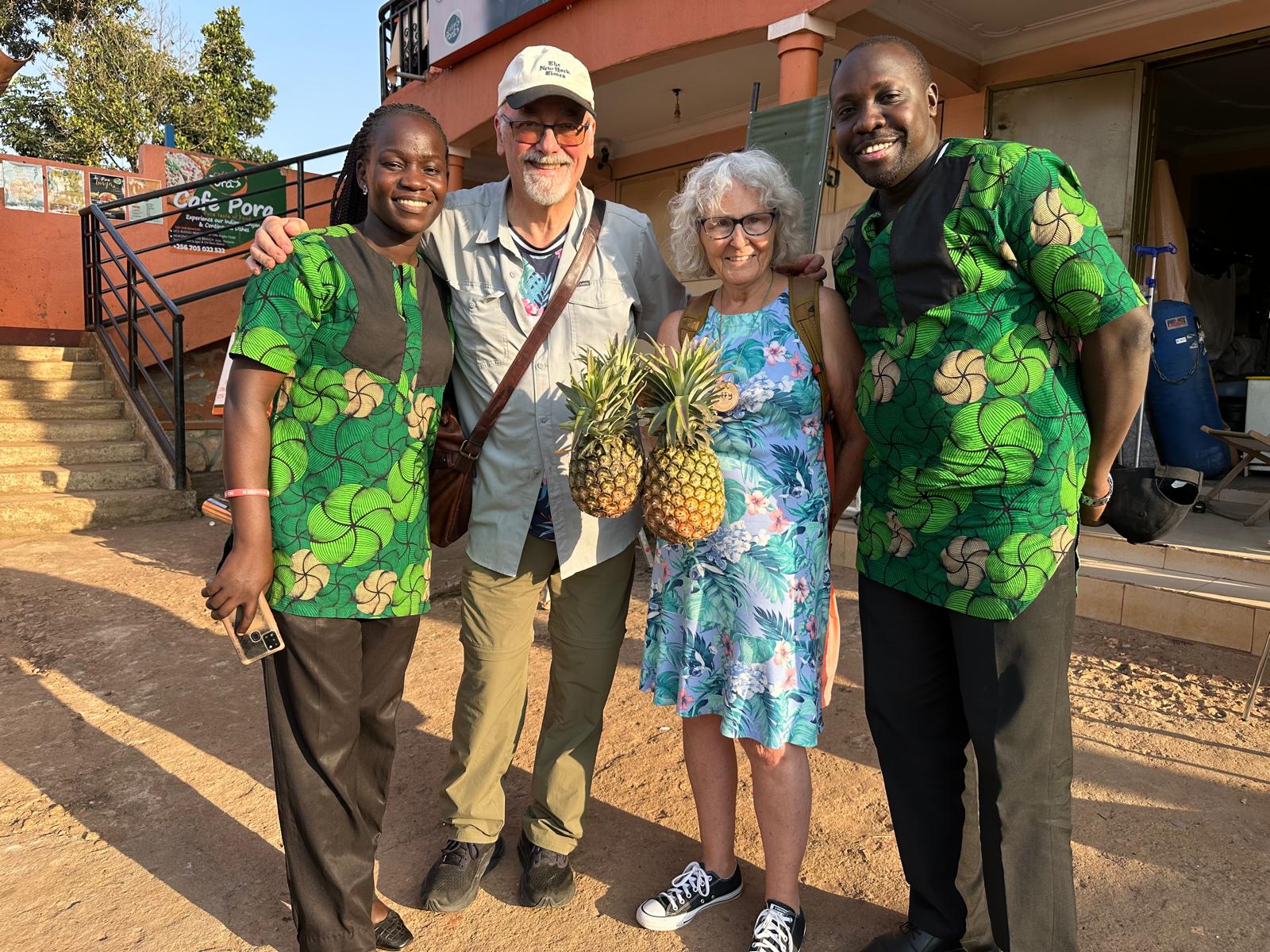
Ugandans Sarah and James Walamaku with Americans Patty Huston-Holm and Mike Holm, holding pineapple purchased in Luwero this summer
“I’m living on 60 percent of what I get and sending the rest home,” she said in one WhatsApp call.
During close to 10 years, Sarah persevered in an environment outside of her birthplace. She flew back and forth to Uganda, got married, had two children, Shalom and Shiloh. As the opportunity allowed, she brought her husband, James Walamaku, and their son and daughter along. At some point, she paved the way for two brothers to join them as well. One brief visit brought her mom into the country.
Money was better than in Uganda, but the Walamakus experienced discrimination from Philippines, Egyptian and Indian cultures.
“Sometimes, they hold their noses when they see us,” James said of the lighter-skinned associates.
Survival, resilience and hope.
As visas expired and renewal became more difficult, the Walamakus returned to Uganda where finding a living-wage job or any job is beyond challenging. Education, which was initially Sarah’s third choice for a career, became her fall-back.
“I wanted to be a journalist like you,” she said of her early professional thoughts. “But people here said it was a tough life and that reporters were getting beaten up all the time.”
Sarah’s second choice was law, but a pastor steered her to education. She has no regrets and despite leaving when living conditions were dire and payment diminished, she felt her time at each school made some positive impact.
“I wanted to give these young children hope,” she said as we approached the Luwero school. “They are very far out of the town, and they need to see that people can still make it.”
There, in front of a room of 100 students, I talked about the children’s book I wrote. Thereafter, my husband, Mike, and I gave a short program of music, including a song (“Que sera, sera” popularized by Doris Day in the 1950s) dedicated to Sarah; and some female students performed a dance.
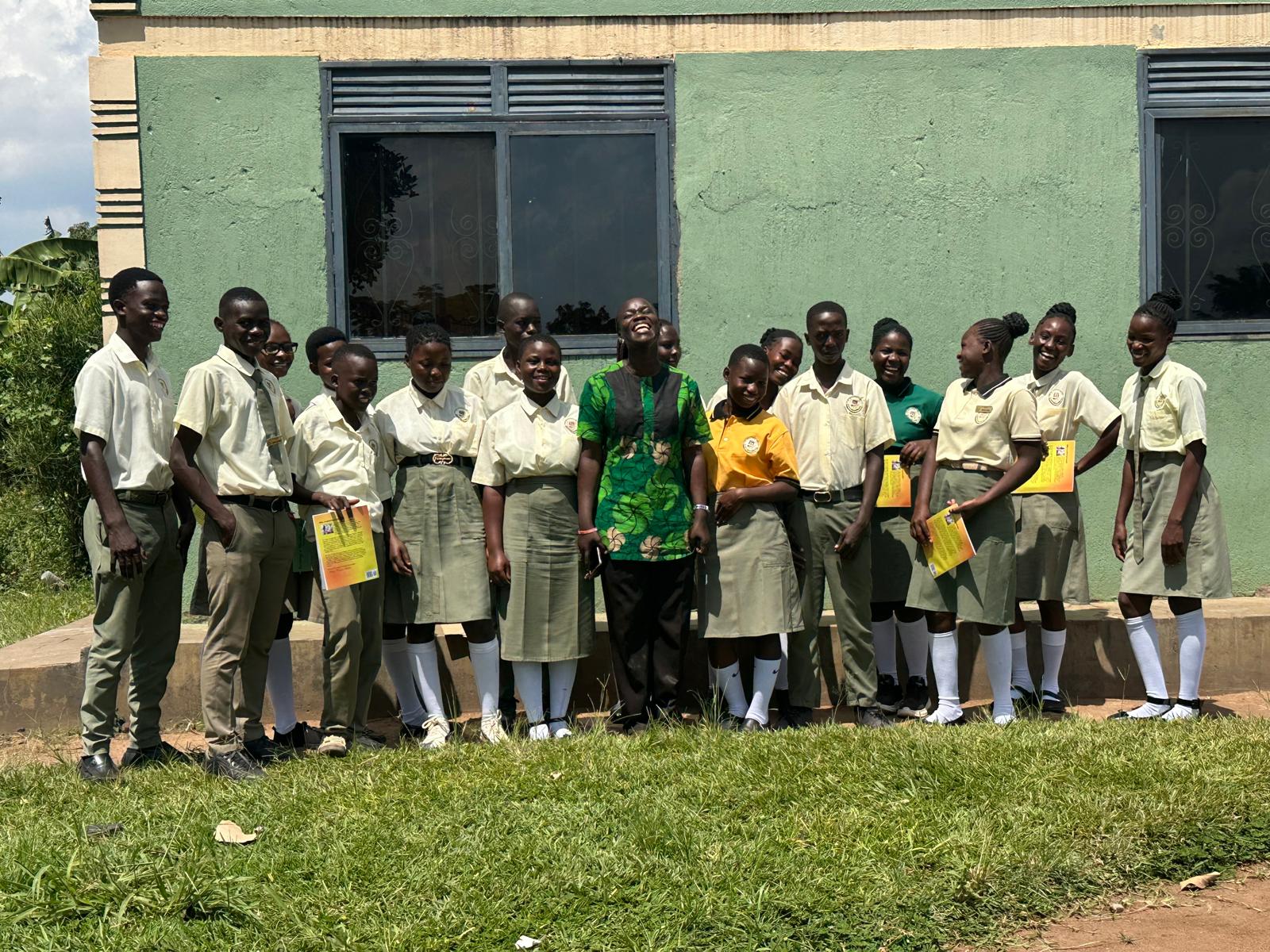
When taking photos before our departure, some of the students were crying. They knew Sarah was leaving, but still took it hard. Her time with them was short in days but long in hours as most days she worked at the school and among her students’ houses for up to 13 hours a day.
On the way back with Sarah’s husband, James, among us, I thought about her life lessons, how I was wrong to worry about her in Dubai and wondered out loud what might be next.
She talked about work with a Uganda bamboo organization with paid positions that she and James hoped to get by year’s end.
I asked what job might be most fulfilling. I asked her to share what she most hoped.
“My dream is to build my own school,” she said. “I now know what is required and what it shouldn’t be. It gives me joy to teach something and see someone learn it.”
++++
To support UCU programs, students, activities and services, go to www.ugandapartners.org and click on the “donate” button, or contact UCU Partners Executive Director, Mark Bartels, at m.t.bartels@ugandapartners.org.
Also, follow us on X (formerly Twitter), Instagram and Facebook.
Discover more from Uganda Partners
Subscribe to get the latest posts sent to your email.