
By Eriah Lule
Just before his graduation in 2018, Ian Benywanira, a Uganda Christian University (UCU) alumnus, was deeply exposed to the practical realities of food insecurity, low productivity and the limited adoption of sustainable farming technologies.
Part of that exposure occurred during a community outreach of the UCU Faculty of Agricultural Sciences at Katente Subcounty, Mukono district, in the central part of the country. Ian realized that to battle such gaps in the agricultural sector of the country, research was a vital tool to generate solutions tailored to address farmers’ problems.
In 2019, with a burning zeal to help farmers, he asked to volunteer at the National Agricultural Research Organization (NARO) Zonal Agricultural Research and Development Institute (ZARDI) Mukono branch, where the 32-year-old is currently a Research Assistant.
“My role involves working closely with lead researchers to interpret findings and contribute to technical reports, publications or presentations,” he said.
In 2020, Ian developed a Nitrogen (N03) fertilizer which is made out of air and water as raw materials. He envisions his fertiliser to boost Uganda’s agricultural productivity and sustainability by enhancing nutrient availability and improving nitrogen use efficiency by farmers.
It will lead to healthier crops, higher yields, and more consistent harvests, contributing to the food security and tax of the country.
“This fertilizer can empower smallholder farmers across Uganda with a reliable and efficient input that aligns with climate-smart agriculture practice, and reduces dependency on imported nitrogen fertilizers,” he noted.
Ian’s fertilizer work has enabled him to fully fund his Master of Science in Crop Science (Agronomy) at Makerere University.
“We have tested it on rice and maize plants both in the screen house and in the field, and the results were fulfilling,” he added.
Being a new innovation, he noted that there is need for more studies to be done. However, inadequate funding has snailed the progress.
Ian credits his education background from UCU that laid a firm foundation for both his technical knowledge and ethical approach to agricultural research. The holistic training shaped his approach to research, encouraging him to prioritize solutions that are not only scientifically sound, but also socially responsible and aligned with the real needs of farmers and other related stakeholders.
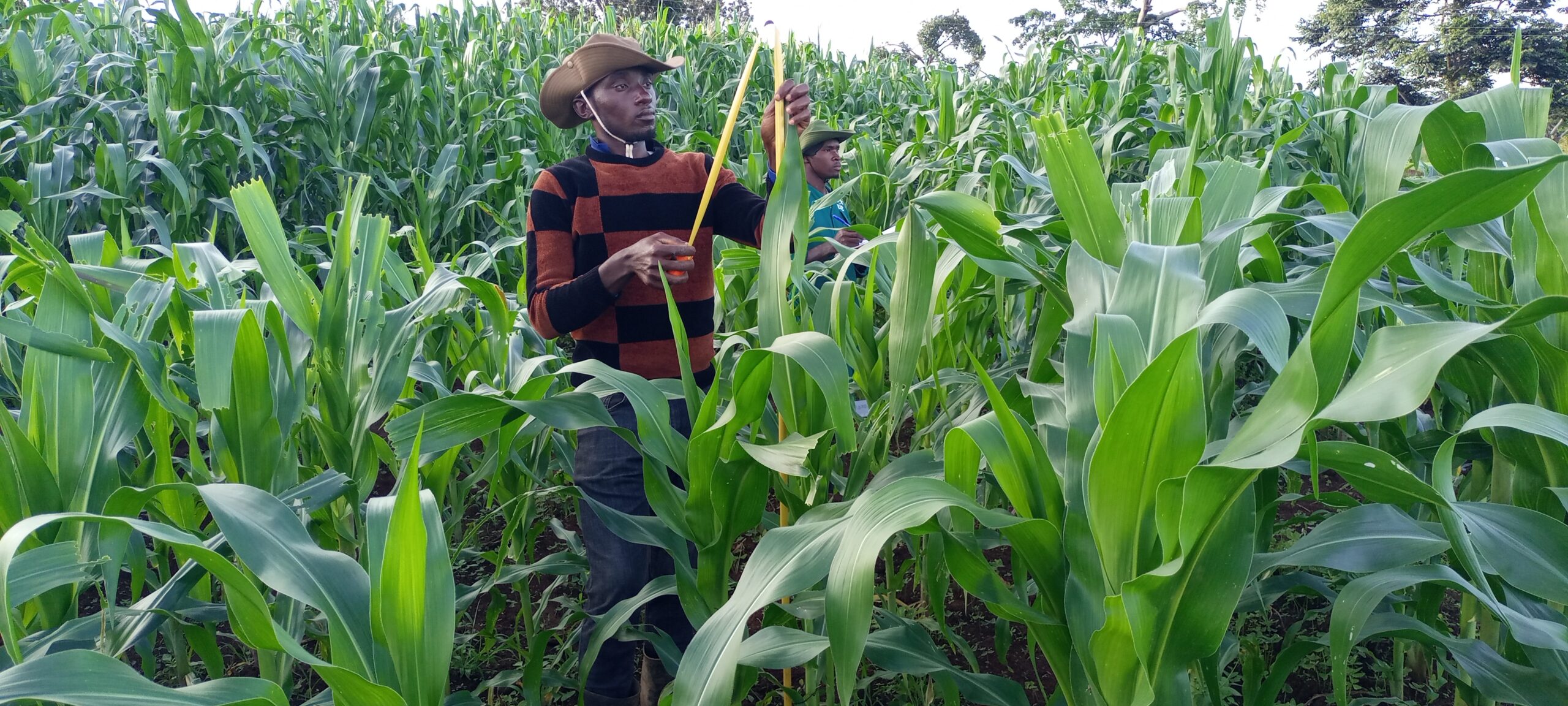
Ian in one of the gardens collecting maize-growing data and plant height (Courtesy Photo)
“I was taught to hold agriculture not just as a profession, but as a mission to serve communities, fight poverty and promote sustainability,” he said. “This mindset continues to guide how I design and implement my research.”
Currently collaborating with scientists from Makerere University, Ian is part of the NARO-ZARDI team that is conducting herbicide efficacy trials of new products which are set to be approved by the Ministry of Agriculture Animal Industry and Fisheries to go on the Ugandan market for farmers to buy.
In his role at NARO-ZARDI, he directly trains and supervises internship agricultural students from different universities across the country, including his alma mater’s, a gesture he feels is part of giving back to UCU.
He dreams to be remembered as a scientist who championed sustainable, farmer-centred solutions and contributed to building resilient food systems in Uganda and beyond, through improved crop varieties, environmentally-friendly farming practices, or empowering young scientists and rural communities. His goal is to make agriculture more productive, inclusive, and climate-smart.
Born to Mbaga Nshambu Kareireho and Ninsiima Jenipher, in Kiruhura district, in the western part of the country, Ian is the couple’s first born of their five children.
+++++++++++++++++++++++++++++++++++++++++++++++++++++++++++++++
To support UCU programs, students, activities and services, go to www.ugandapartners.org and click on the “donate” button, or contact UCU Partners Executive Director, Mark Bartels, at m.t.bartels@ugandapartners.org.
Also, follow us on X (formerly Twitter), Instagram and Facebook.
Discover more from Uganda Partners
Subscribe to get the latest posts sent to your email.