By Patty Huston-Holm with Contribution by Frank Obonyo
In early January 2009, Francis Ojok, a seven-year-old boy with burns on 90% of his body, tearfully shared the tragedy of his fate that was even more catastrophic for his grandmother, mother and seven siblings who died in the fire. The Daily Monitor published his account of the out-of-control inferno that was started by local men seeking to root out edible rats in northern Uganda’s Ojile village, Pajule Sub-county in Pader District.
Paul Amoru, then 25 and a recent graduate of the mass communications department at Uganda Christian University (UCU), wrote that story. Patiently waiting at one point for 10 minutes as the sobbing boy gained composure, he did the interview and sensitively captured an accompanying photo showing purplish burns on Ojok’s back and skull.
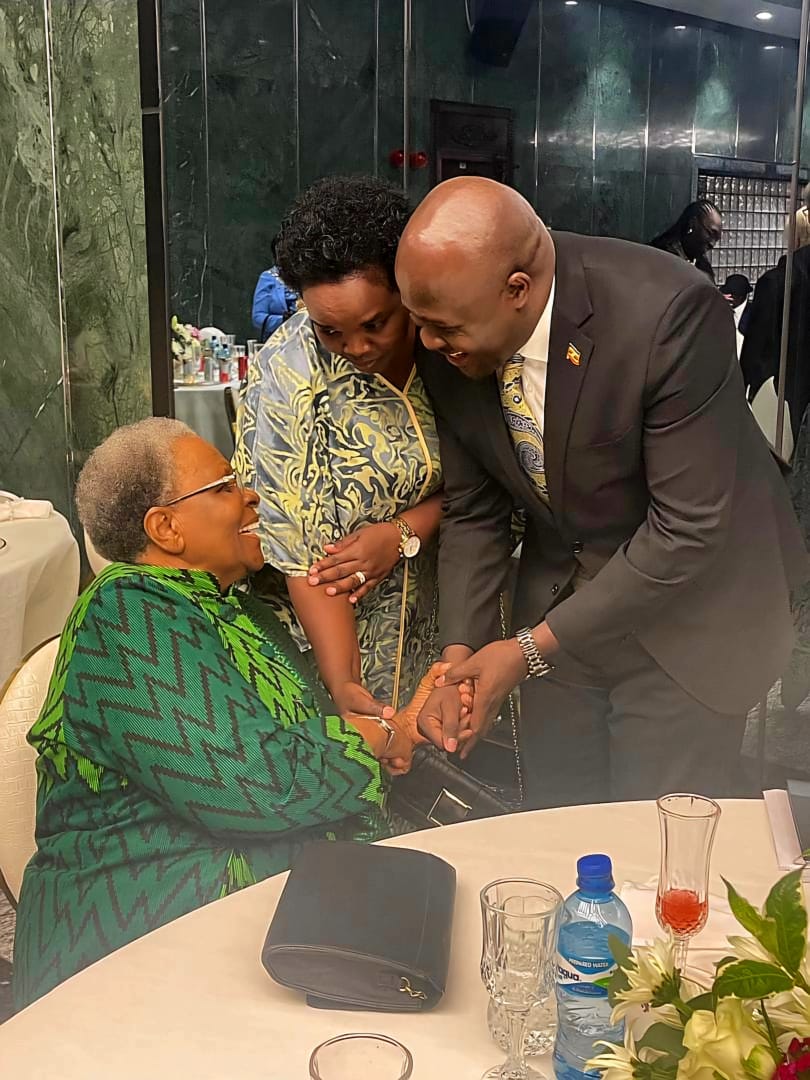
Uganda’s Non-Resident High Commissioner to Namibia, Paul Amoru, accompanied by his wife, Eunice Chelangat, greets Namibia’s President, Her Excellency Nandi-Ndaitwah, during a reception at State House in Windhoek.
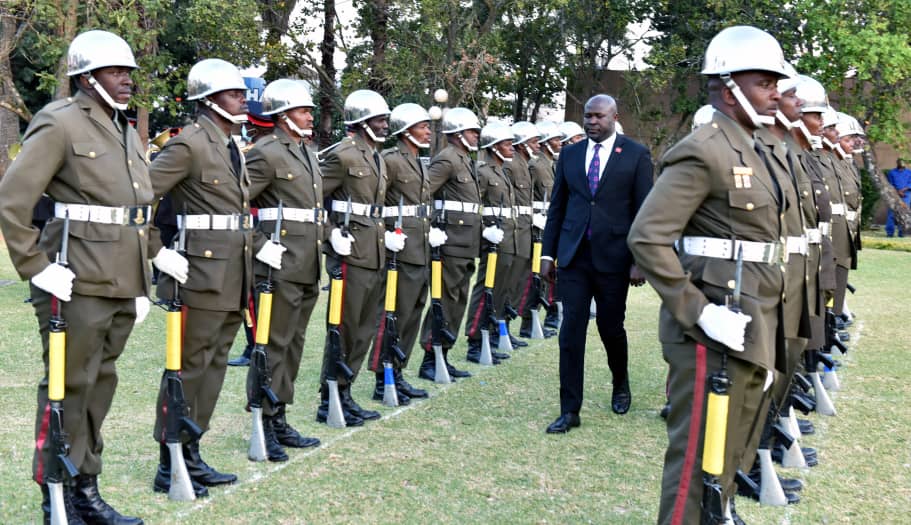
Born in Dokolo District in the Lango sub-region approximately 200 kilometers (124 miles) from where that incident took place, Paul Omiat Amoru started his career sharing information about people, places and things – something he still does but not for a media house. As Uganda’s Ambassador to South Africa since 2021, the now 42-year-old tells his country’s stories with the same servant-minded intent of his younger years as a journalist, a news bureau chief and a communications officer but through a government-focused lens.
“Every position I’ve held is defined by service,” Amoru said. “I am humbled and grateful to God for any blessings, to my president (Yoweri Museveni) for the honor of representing my country and so much more.”
Minus the “Omiat” name associated with his father’s surname, Paul Amoru (last name from a grandfather and meaning “rock”) also goes by the title of High Commissioner of the Republic of Uganda to the Republic of South Africa as well as High Commissioner for the countries of Botswana, Namibia and Zimbabwe and the kingdoms of Eswatini and Lesotho. Residing with his wife, who he met while both were UCU students, and four children in Pretoria, South Africa, he serves in what is considered one of Africa’s four key diplomatic hubs among three dozen Ugandan ambassadorships. Kenya, Nigeria and the Democratic Republic of the Congo are Uganda’s other three vital continent focal points for international relations, negotiations and global policy-making.
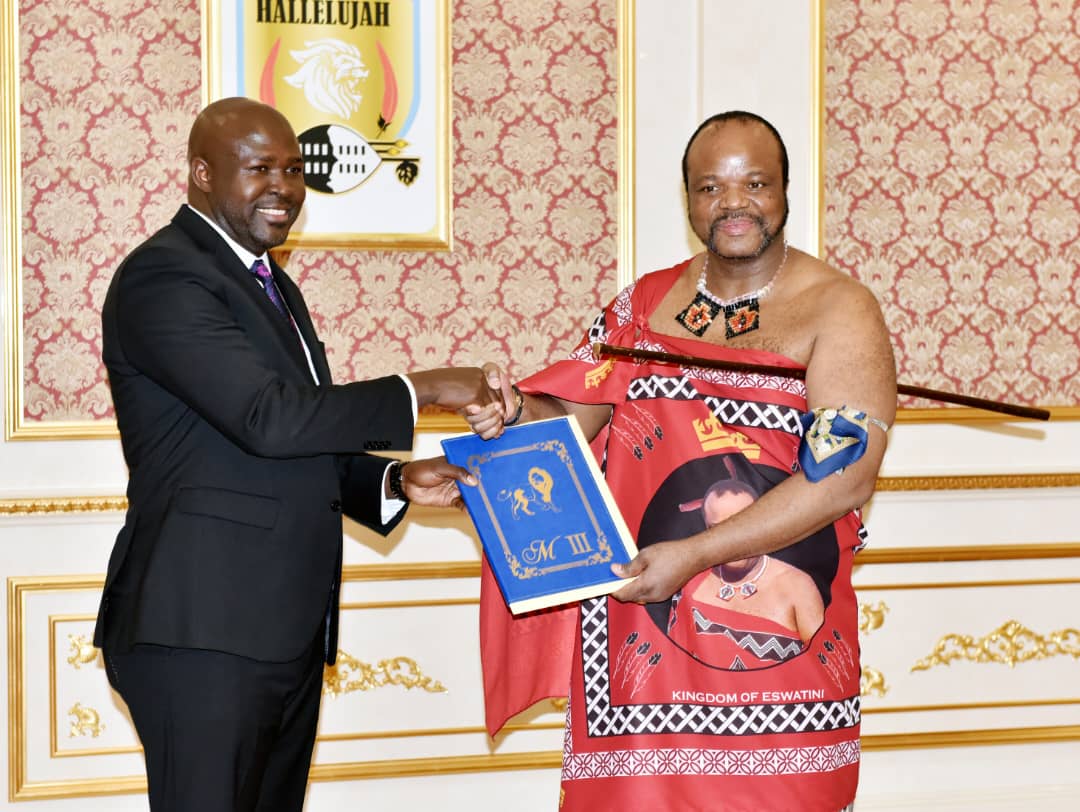
Ambassador Paul Amoru, left, Uganda’s Non-Resident High Commissioner to Eswatini, receives a gift from His Majesty King Mswati III of Eswatini after presenting his Letters of Credence at the Royal Palace.
In the ambassador role, Amoru represents 50 million people living in Uganda and an estimated 500,000 Ugandans living and working in South Africa. He shares their success stories in multiple areas, including education, agriculture and business, and promotes their achievements, encourages and attracts investments and mobilizes the diaspora.
Amoru is well-versed in Uganda’s kingdoms, clans and tribes with more than 50 languages and dialects which pose communication and cultural challenges. He is aware of his country’s poverty and corruption pockets. He knows about the burden of preventable diseases like malaria. The one-time journalist and news bureau chief once reported and guided reporters to share news about East Africa problems like these while “holding the powerful accountable,” he said.
“I remember covering the International Criminal Court’s role in Uganda, investigating land grabbing cases by powerful individuals,” he said. “Those stories exposed corruption that led to government investigations and arrests.”
Fast forward to 2026.
Amoru is often the mouthpiece for Uganda’s most powerful leader, President Museveni. Whether in South Africa, Israel, Australia, the United States or another country, the ambassador uses the same relationship-building strategies he once employed as a journalist getting a story for today’s sharing and growing positive aspects of his country within and outside Uganda.
“President Museveni’s message focuses on economic prosperity and growing Uganda’s economy tenfold in the next 10-15 years,” Amoru said.
Supporting components of this broad vision range from the commercial production of coffee, gold, oil and e-buses to the tourist attractions of waterfalls, lakes and wildlife and college degree intellectual assets.
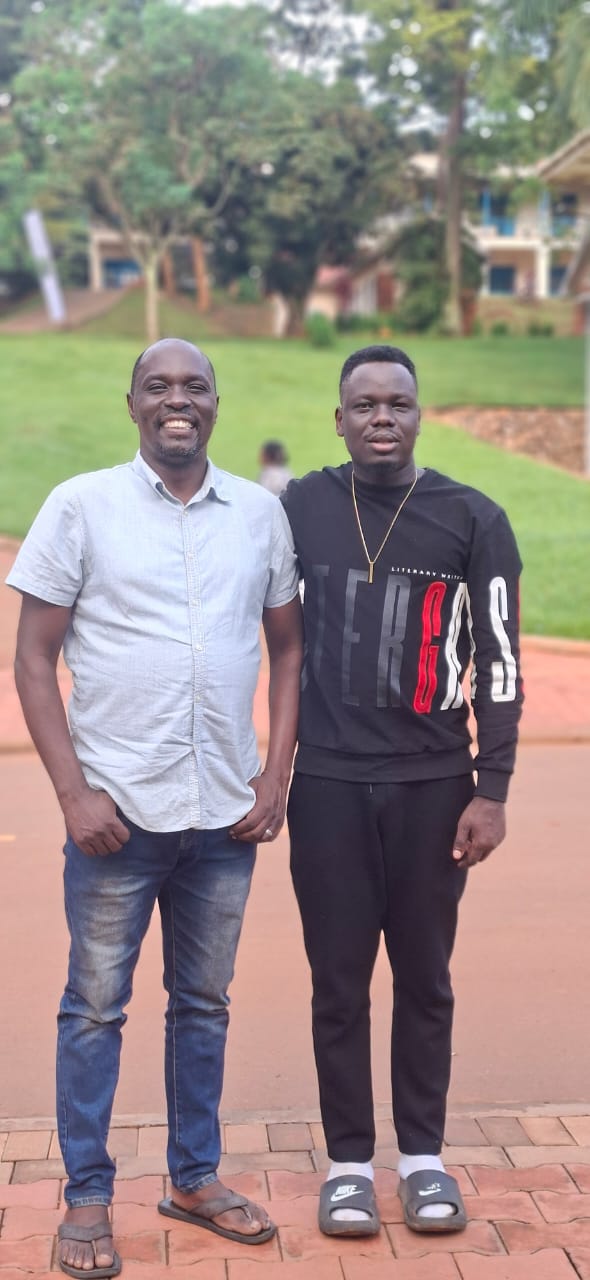
Francis Ojok, right, on the UCU campus during a recent conversation with Frank Obonyo, left, who teaches in the university School of Journalism, Media and Communication.
“Uganda has a state-of-the-art electric-bus,” Amoru said. “Kira Motors is the first and biggest electric vehicle plant in Africa. The bus that the Eswatini and other governments and private sectors are looking at now is made and tested in Uganda.”
In November 2025, the Uganda High Commission in Pretoria, together with the Ministry of Science, Technology and Innovation coordinated visibility for e-mobility projects with a showcase of the e-bus capacity and resilience as it covered 13,000 kilometers (8,077 miles), repowering every 500 kilometers (311 miles).
Under more good news:
- Uganda is the largest coffee exporter in Africa.
- Gold exports accounted for 37% of Uganda’s total export revenue in 2024.
- Entrepreneurs like Andrew Mukiibi of Federal Foods Company have set up businesses in South Africa to import Ugandan products like pineapples and avocados and to export South African apples to Uganda.
- Long-horned cattle mostly raised in western Uganda are prized for their lean beef and rich milk.
“Ankole cows – something many might not think about – are highly valued,” Amoru said. “People want our cows. Some South African auctions get $70,000 per cow.”
According to Amoru, universities in Uganda have more than 40,000 graduates a year with an increasing number getting jobs both in and outside the country.
At the same time Uganda is lifting itself up, it extends a helping hand to neighbors. Amoru discussed Uganda’s role as Africa’s largest refugee-hosting nation, currently sheltering nearly two million evacuees and asylum seekers.
“There are wars all around us – South Sudan, the Democratic Republic of Congo, Somalia – but Uganda remains an exporter of peace,” Amoru said. “We are helping people wanting to escape conflict.”
On this day, May 14, 2026, the ambassador is in Uganda following a May 12 public holiday to honor President Museveni being sworn in for an historic seventh term. Dignitaries present for festivities in Kampala were presidents of Tanzania, South Sudan, Somalia, Ethiopia, Mozambique and Togo, among others.
“People elect because they believe,” Amoru said, noting Museveni’s most recent 71.6% voter approval. Of the President’s reported age of 81, the Ambassador noted “with age comes experience, insights and understanding.”
The following day, May 15, Amoru was in Botswana, representing Museveni at the funeral of former Botswana President Festus Gontebanye Mogae. Amoru’s remarks on behalf of the Ugandan president included commendation for Dr. Mogae’s “bold fight against HIV/AIDS” and his “steadfast commitment to democracy and Pan-Africanism.”
Amoru was age three when Museveni became president in 1986. What he first learned about the man who has been Uganda’s president for the last 40 years was mostly from his Lira District (northern) primary and Ngora District (eastern) secondary school studies, including how Museveni and the National Resistance Movement (NRM) suppressed militant extremist groups. One such group, the Lord’s Resistance Army, was known to kidnap young boys in the region where Amoru grew up.
“I wasn’t thinking about politics back then,” Amoru, the second born of eight children, said. “My father wanted me to be a lawyer as I was leaning toward the news media.”
Amoru’s journey into politics began alongside his UCU undergraduate journalism and public relations studies. When he became president of the UCU Students’ Guild in 2005, he was the first non-law, non-theology student elected to leadership for the organization that serves to represent the students’ voice to university administration. In 2006, he received his bachelor’s degree and was chosen to be president of the Uganda National Students Association.
In 2015, Amoru successfully joined elective politics, winning the parliamentary Dokolo North County seat as the NRM flag bearer. However, Amoru narrowly lost his bid for re-election to parliament in January 2021, accepting the appointment as ambassador by Museveni shortly thereafter.
Amoru’s post-graduate academic credentials include a master’s degree in journalism and communication from Makerere University. He is currently a doctoral candidate pursuing a philosophy of international relations degree at the University of KwaZulu-Natal in South Africa, where, in late 2025, he finalized a Memorandum of Understanding for 200 PhD scholarships for Ugandan citizens. Amoru’s advanced degree research focuses on aid and budget development in countries like Uganda.
Several other Ugandan nationals are pursuing doctoral studies as part of Amoru’s cohort and through the support of Janet Museveni, Uganda’s First Lady and Minister of Education and Sports.
While a significant milestone, an advanced degree with a body of research within a thesis is not a legacy, Ambassador Amoru said.
“I am still a work in progress,” he said. “By God’s grace, I hope to do more. The Bible has several passages addressing how more will be added unto you if you are faithful. My legacy is unfolding.”
As for the boy he interviewed 17 years ago, Amoru recently learned good news. After that fiery ordeal, the boy was adopted by a Ugandan man (now deceased) who was married to an Australian woman. Francis Ojok was taken to a children’s home where he grew up to age 16 without finishing his education. When he moved from the home, he learned how to drive and do odd jobs without formal education or qualifications.
On May 31, 2026, Ojok, now age 24, traveled to the UCU campus, where he emotionally shared the follow-up to his tragic story – one that has all physical wounds condensed to scars on his back but psychological wounds present everywhere. He is a lay minister in Worship Harvest Church in Kampala, where he helps with sound and public address systems and has an occasional job of driving a taxi with aspirations of owning a car to better support himself in the transport business.
“I struggle to be independent while feeling so very alone much of the time,” Ojok said in perfect English during a two-hour discussion with Frank Obonyo, who teaches within the UCU School of Journalism, Media and Communication. “Whenever I think of that day, it all comes back, triggering those feelings of loss and the memory of my mother’s voice telling me to run, which I did.”
++++
To support UCU programs, students, activities and services, go to www.ugandapartners.org and click on the “donate” button, or contact UCU Partners Executive Director, Mark Bartels, at m.t.bartels@ugandapartners.org.
Also, follow us on X (formerly Twitter), Instagram and Facebook.
Discover more from Uganda Partners
Subscribe to get the latest posts sent to your email.