By Irene Best Nyapendi
It is often said that if you think you can win, you will. Growing up, Tirza Atwiine was drawn to the possibilities of innovation to create solutions that change lives. That desire never waivered.
Take, for instance, her recent undergraduate project that she did as a student of Bachelor of Science in Computer Science at Uganda Christian University (UCU).
Atwiine’s final-year project tackled one of the pressing health concerns in Uganda – the sickle cell disease. Through intense research and study, she developed a system that can be used to predict risks in sickle cell patients by analyzing their Complete Blood Count (CBC) data. The system looks at past data to forecast future CBC values. This, she explained, helps doctors to know what medication to prescribe and avoid. This project, if implemented, Atwiine noted, has the potential to enhance patient care.
One would wonder why Atwiine’s mind wandered to the field of health care. The United Nations General Assembly has recognized sickle cell disease as a global public health problem because of the weight of its burden, especially in the Sub-Sahara area. Many children with a severe form of the disease die before age five. In Uganda, statistics place the sickle cell trait to as high as 25% in some parts of the country.
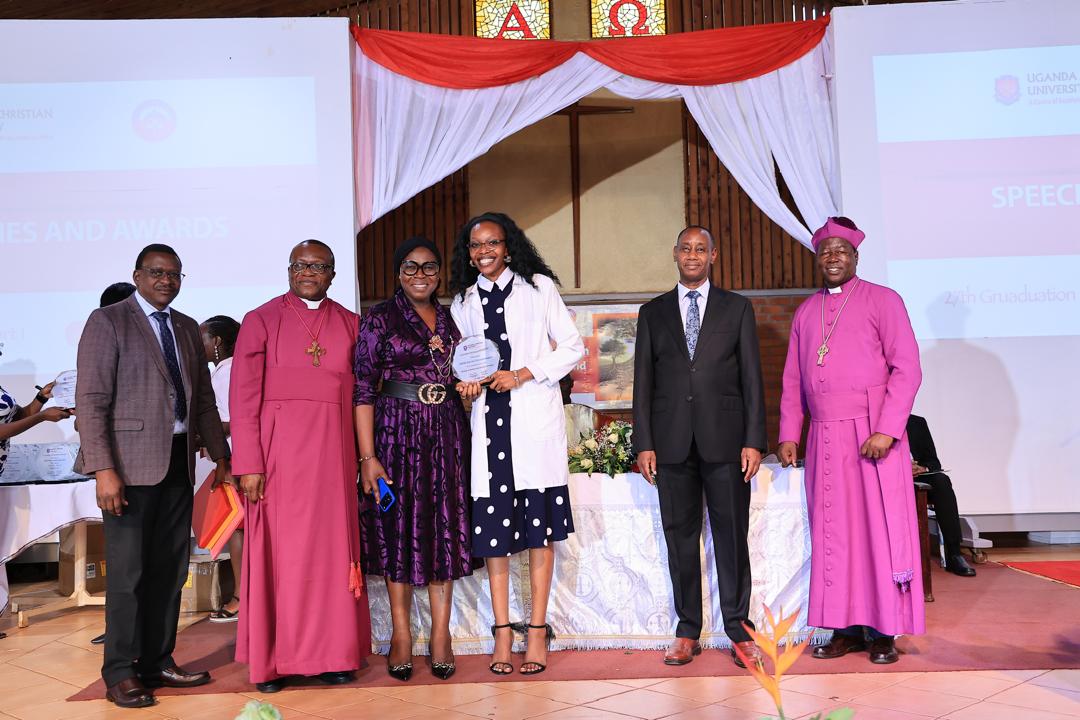
Atwiine was not just among the 1,524 students who graduated on July 4, 2025, but was also among the 49 students who received a First Class at the graduation ceremony held at the UCU main campus in Mukono.
“I feel so happy; when I was a student, I was always counting the years, waiting for graduation,” she said. “Now that it’s here, I feel I have fulfilled my dreams, and I’m excited for what’s next.”
Atwiine’s Grade Point Average of 4.79 out of 5.0 didn’t come by chance; it was a result of deliberate strategies and a relentless drive to learn. She always loved to read ahead, making sure she had the basics before walking into a lecture. She also took the time to understand each course unit and her lecturers’ expectations, which helped her tailor her efforts to meet their standards.
At UCU, Atwiine lived by the mantra of leading by learning and learning by leading. For instance, she held leadership positions such as class representative, president of the Robotics Club and Code Buddy mentor. Such responsibilities, she argues, taught her to manage her time well and to prioritize in cases where activities overlapped.
Atwiine knew firsthand the challenges of navigating university life alone as a new student. To prevent others from facing similar struggles, she dedicated herself to mentor six students through the Code Buddy Mentorship Program that UCU’s Department of Computing and Technology launched on Sept. 20, 2024.
“I don’t want new students to make the mistakes I made,” Atwiine told Partners last year, noting that she had been able to learn more, by teaching others. “I’ve discovered that when I explain concepts to my mentees, I find it hard to forget the same concepts.”
More recently, Atwiine worked on an AI-activated tutor robot named Tiana, designed to make learning fun and interactive.
“Tiana is voice-activated, you can talk to it like a friend would, ask questions, and it answers, making learning easier and more engaging,” she explained.
Atwiine was among six UCU students who were recently recognized for their remarkable technical contributions at a national aerospace mission ideation workshop that focused on satellite domestication in Uganda.
Atwiine and colleagues were recognized for a space mission concept to address Uganda’s pressing environmental issues using satellite technology. The team proposed to monitor deforestation by capturing satellite images of vegetation cover over time. By comparing satellite images taken at different intervals, the team aimed to detect environmental degradation and help in forest conservation efforts. They also proposed using sensors to track poaching activity in game parks, identifying abnormal movements of animals as potential signs of illegal trapping threats.
The 22-year-old credits her success to God, colleagues and her mentors who believed in her potential. Her lecturers, such as Ian Raymond Osolo, John Bosco Wabwire Habere and Dr. Innocent Ndibatya, she says, gave her guidance, including inviting her to attend robotics seminars and events – something she says broadened her knowledge.
“I wouldn’t be this successful in robotics without the support of my lecturers,” Atwiine acknowledged.
Now that she’s graduated, Atwiine is looking forward to becoming a data scientist and a robotics engineer. Her vision is to use her skills to create solutions that improve lives, whether through analyzing data to inform decisions or building robots that solve practical problems.
When asked to describe her UCU experience, she does so in three words: Transformative, Rewarding and Humbling.
++++++++++++++++++++++++++++++++++++++++++++++++++++++
To support UCU programs, students, activities and services, go to www.ugandapartners.org and click on the “donate” button, or contact UCU Partners Executive Director, Mark Bartels, at m.t.bartels@ugandapartners.org.
Also, follow us on X (formerly Twitter), Instagram and Facebook.
Discover more from Uganda Partners
Subscribe to get the latest posts sent to your email.