Story By Patty Huston-Holm
Photos by Andrew Bugembe
The story of a person’s life doesn’t often start by talking about the mother. But maybe it should.
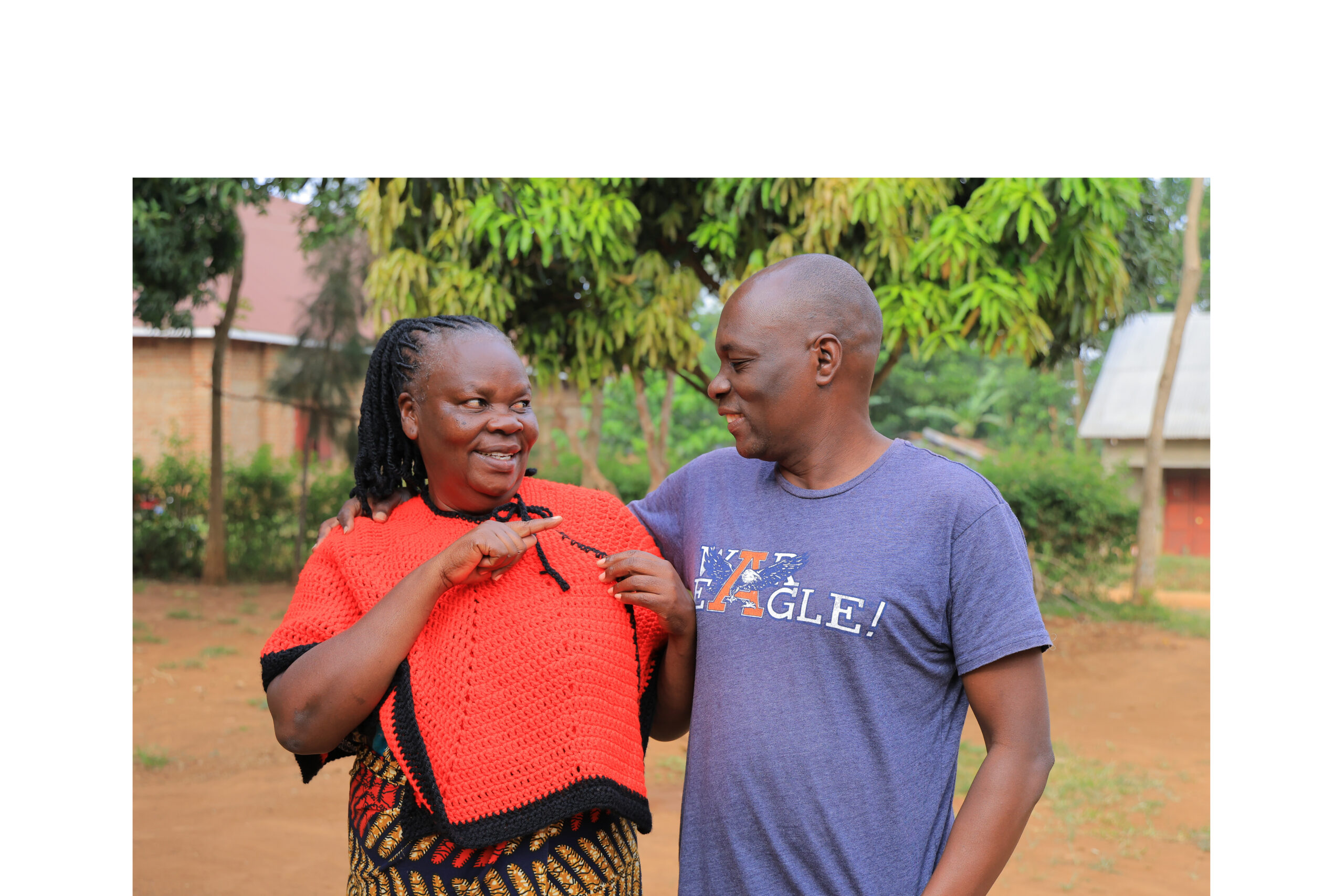
Under a nearly cloudless sky in the late June 2026 heat, Betty Obonyo walked across the dirt and yellowed grass of a nearly deserted school yard in the village of Per-Per, one of more than 1,300 villages in Eastern Uganda’s Tororo District. Her first-born child, Frank Obonyo, a Uganda Christian University (UCU) bachelor’s graduate now working on his PhD in UCU’s School of Journalism, Media and Communication (JMC), was nearby but not within earshot.
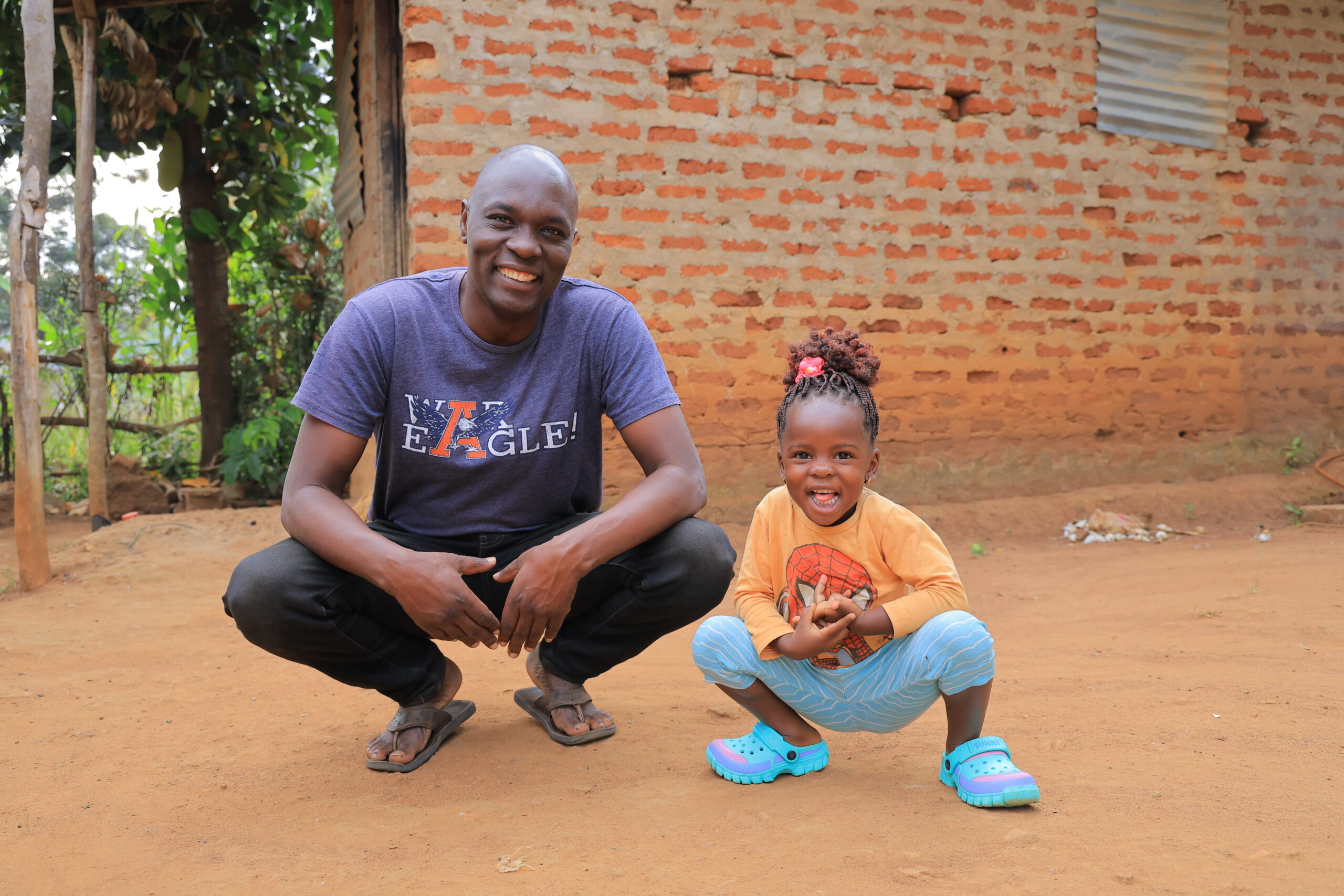
Frank Obonyo with his two-year-old niece, Kimaya Aboth, during a summer 2026 visit to his native Per-Per Village
“My sister worked here,” 63-year-old Betty said, motioning around the grounds. She grinned.
Just like it was yesterday, she shared how the sister asked her to buy some fish, how a man about 13 years older took notice of the then 17-year-old making a purchase and recalled the man’s words loud enough for her to hear not in Dhopadhola, which is the indigenous language of Per-Per’s Jopadhola, but in English: “I want to meet that beautiful girl.”
Soon after, Betty met Johnny Obonyo Wakiti, the man behind the voice. Within a year, they got married. On Sept. 1, 1982, at the age of 17, Betty gave birth to Frank – a boy that she and her new husband hoped for. It was uneventful except that Betty and her new baby stayed in the Nagongera Health Center for nearly a week so the teenager could learn how to be a mother, including breastfeeding.
Betty, it seemed, was the right temperament for Johnny, who had another wife for 10 years. She took care of Frank, five more children she had and another five by the first wife – “all the same,” according to Frank. “She washed all our clothes, made sure all 11 of us had the same food, same schools and same opportunities to be successful.”
For Frank, who will turn 44 in September, success is not about university degrees (he has three and is working on a fourth), titles (he has had a half-dozen elevated ones) but about giving to others. His parents served as role models for that. Compassion seemed to come naturally for his mom. His father consciously strived for it. Johnny Obonyo, who lost a battle with cancer in August 2025, was driven to caring.
“My grandfather, a policeman with the name Owino, I was told was unkind to my grandmother who he regarded as illiterate,” Frank said, sharing one example of harm in that after having one child, Johnny Obonyo, the grandmother could have no more. “My dad was determined he would not be the harsh role model his father was…He would spank us or hit lightly with a stick to correct for maybe being late for a meal but not punish in anger.”
Frank recalled a father who encountered people needing food, clothing, shelter and providing it to the point that their house might have “as many as 22 people” living and sleeping there. His heart of giving seems to originate from his forefathers. His great-grandfather, Ezekiel Nyanjeye Obonyo, donated land first to a church and then a school. Today, the family’s rural Per-Per property, accessible by a rugged, dusty road, contains a primary school with more than 1,000 students.
“This, too, will be my home one day,” Frank motioned to roughly an acre containing a small, wooden latrine and sun-parched grasses that could be replaced with maize and cassava crops. “I built the latrine. I’ll build a house and move here at maybe age 65.”
While the house Frank shares with his wife, Cathryn, and three children is in Mukono and most of his early education was from Kampala-area schools, the impoverished Per-Per village he moved around in the weekend of June 26-28 is “my home,” Frank asserted unapologetically.
It is here where he remembers playing with discarded vehicle tires, engaging in football (soccer) and “shooting” guns made from branches of the papaya tree. Here, he eats millet bread and not matooke and fried grasshoppers as people in Mukono and Kampala do. Here, he was a quiet, sensitive boy except for the one time when at age seven, he broke his arm when playfully trying to kick but missed his elder sister Jennipher.
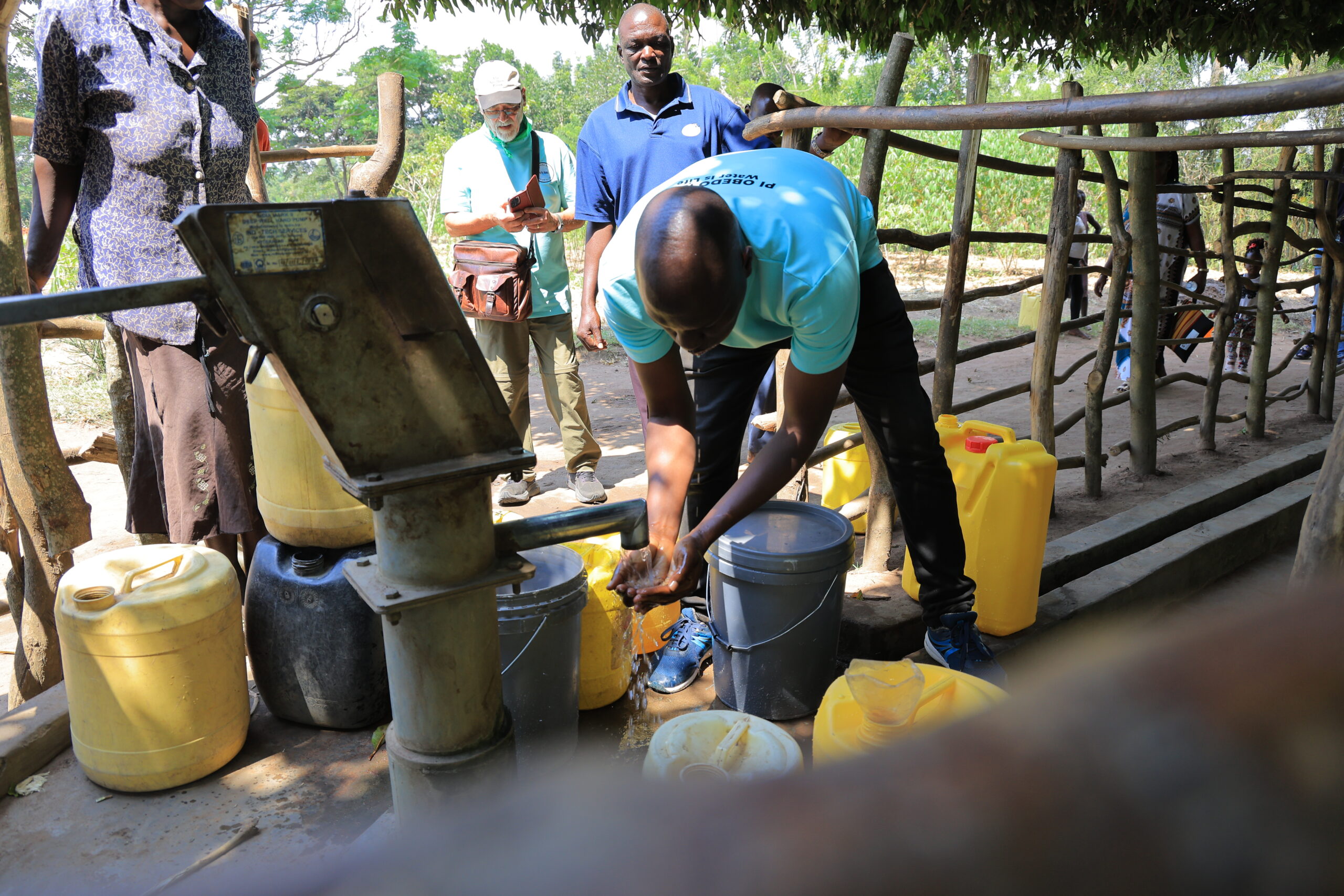
Frank Obonyo tastes water at one of three borehole projects he has led within his native village. Making notes on his phone in background is Ohio resident Mike Holm, one of the Americans who helped fund the clean water under Frank’s leadership.
Four years after Frank was born, Betty gave birth to Irene alone in the middle of a banana plantation in Port Bell, Luzira, a Kampala suburb. It was 1986 – a time when now President Yoweri Museveni and his National Resistance Army (NRA) were concluding a five-year guerrilla war. The Obonyos weren’t a political family, but because of his ethnic association, Johnny Obonyo once had his shoes and watch stolen by the NRA. Thus, several times the family slept and hid “in the bush…hearing soldier’s boots hit the ground” around them, Frank said.
At 2 a.m. on the day of Irene’s birth, “I bit off the umbilical cord, tied it with cloth…and carried the baby to a health center,” Betty said.
That baby, Irene Alwenyi, is a master’s degree graduate from the University of Galway in Ireland, working with Uganda Investment Authority. All 11 children finished high school and have careers in social work, public relations, business, medicine and more.
Recalling Frank as a “sensitive” child, Betty said her oldest son “would cry when missing his father,” who was often at work making sh200,000 ($54) a month as a company driver.
In spite of no formal education after primary school, Johnny Obonyo gained mentorship from Prince Peleus Reuss of Switzerland whom he met in Uganda. Peleus left Uganda in 1970 because of political instability in the country at the time. He then arranged for a young Johnny to join him in Switzerland for safety. Johnny interacted with people from different parts of the world. He lived and worked in Switzerland, Germany, Spain, Portugal and the UK.
Frank followed in his father’s footsteps of hard work but shifted when it came to a chosen career path. As a teenager, Frank worked for sh2,000 (54 cents) a day as a cleaner in Uganda Breweries. At the end of each shift, he scooped up sugar discarded to the floor from beer processing, separated the granules from rat droppings and took it home to his mother.
With a love of writing, and despite his father’s suggestion to be a lawyer, Frank leaned into journalism and communication after finishing his secondary studies.
As an undergraduate student at UCU and while his father paid his tuition, Frank supported himself with the sh3,000(82 cents)-a-day he received for teaching English and literature in local secondary schools.
Upon receiving his UCU Bachelor of Arts in Communication in 2006 and “by God’s divine grace,” Frank was one of four interns for the launch of the university newspaper, The Standard, he recalled. Thomas Froese, a Canadian journalist, and the Rev. Dr. Stephen Noll, UCU’s first vice chancellor, started the student newspaper with the guidance of Ben Bella Ilakut, a journalist and then head of what was known as the UCU communications department academic track.
Two years later, Frank and another UCU graduate and work colleague, John Semakula, UCU’s head of undergraduate programs with the School of JMC, were hired by New Vision. Subsequent employers for Frank Obonyo have been The Observer newspaper, Compassion International, Action4 Health Uganda, World Vision, the Law Development Center and UCU’s public relations department and the UCU School of JMC, where Frank has been teaching since 2018.
En route back to Mukono from Per-Per, Frank recalled his first by-line story on music, including that of Bobi Wine, at The Observer. It was with World Vision that he became more interested in clean water and the need for it in economically-challenged areas, including Per-Per.
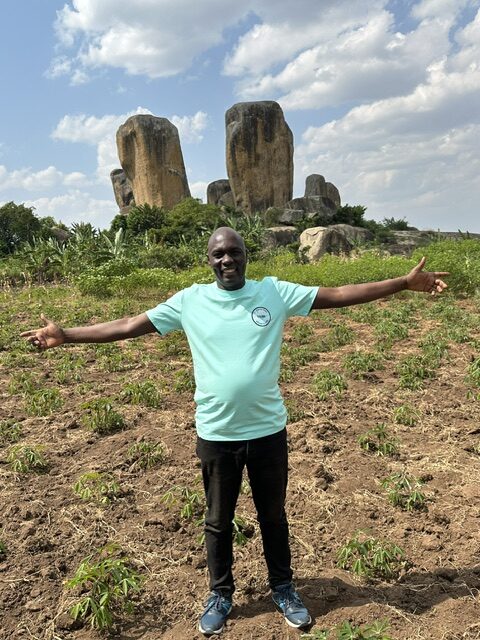
Frank Obonyo poses in front of a formation that locals call “Rock 7” – lesser-known than Tororo Rock, a volcanic formation popular for climbing. The rock behind and rocks around Frank are near where his grandmother was born and are often found with maize and other crops spread about them for drying.
With World Vision and while supporting his siblings with school fees, he traveled to the United States four times – soliciting funds for clean water from residents in Washington, D.C.; Washington State; Oregon; Maryland; and Pennsylvania.
On a trip to Oregon, Frank met Dayna and Howard Collins, children of his father’s friends, Pat and Lefty Davidson, whom he drove in Torremolinos, Spain. When Frank was in Salem, Oregon, Dayna and Howard talked to him about the idea of drilling a borehole. The answer was yes. The need was for three boreholes. They helped with two before Johnny Obonyo Wakiti lost his battle with cancer and took his final breath Aug. 29, 2025.
On June 28, 2026, Frank and representatives of some Ohioans who paid for the third clean water site, saw the progress. There is still much need for water in this little village of Per-Per but the Ohioans’ gift will serve over 3,000 people.
“I wanted to do this for my father,” Frank said. “But if he were here, he would say it’s instead for the community. He was always about giving up his own comfort for others.”
Frank Obonyo shared his doctoral research topic related to communications in Ugandan referral hospitals – something he believes is needed to prolong lives like that of his father. Frank already has advanced degrees in literature and digital journalism. University education has served him well as have his employers.
But as he recalled being near his father’s face with his mom, Betty, at his feet as Johnny took his last breath, Frank Obonyo brushed away the credentials and experience. From his cracked phone screen, he shared his father’s final message: “Keep the old man’s wise words like a precious stone close to your heart, and never let it go away from your heart and soul.”
“Helping others less than you is the simple impact,” Frank said.
The story of a person’s life doesn’t often start or end by talking about the mother and father. But maybe it should.
++++
To support UCU programs, students, activities and services, go to www.ugandapartners.org and click on the “donate” button, or contact UCU Partners Executive Director, Mark Bartels, at m.t.bartels@ugandapartners.org.
Also, follow us on X (formerly Twitter), Instagram and Facebook.
Discover more from Uganda Partners
Subscribe to get the latest posts sent to your email.