By Jimmy Siyasa
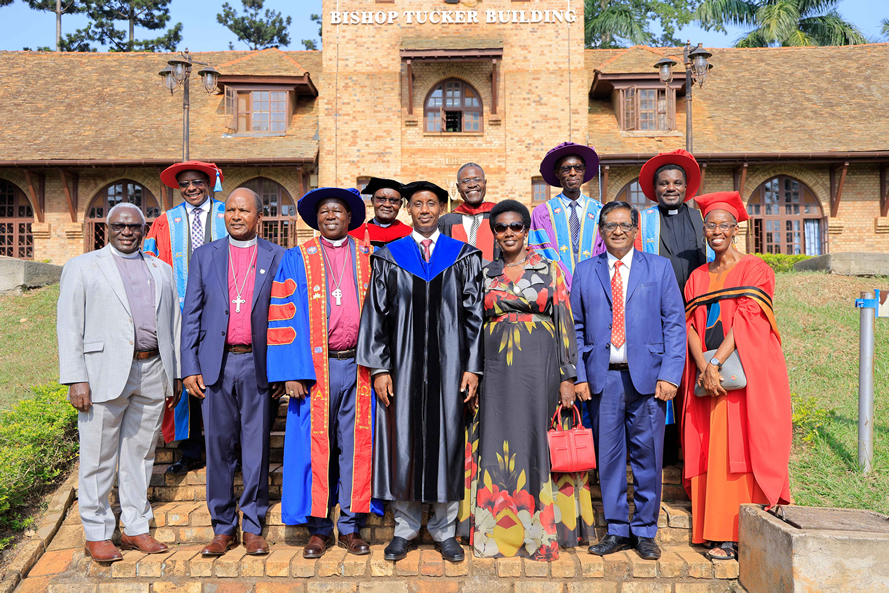
On July 1, 2026, hundreds of students, staff and special guests gathered at Uganda Christian University’s (UCU) Nkoyoyo Hall to watch a historic event unfold — the first time in UCU’s 29 years a Vice Chancellor in office was being unveiled as a full professor.
That afternoon, Prof. Aaron Mushengyezi, who had, until a few days before, gone by the title “Associate Professor”, delivered his Inaugural Professorial Lecture as a full professor. Mushengyezi achieved the rank after years of distinguished research, teaching and service.
An Inaugural Professorial Lecture is given by a PhD-holding academic who has recently been promoted to the rank of full professor.
It is usually a celebratory ceremony to recognize the elevated scholar and to formally introduce them to the public.
“It gives a professor an opportunity to stand before the public and say-this is the field to which I have given my mind,” UCU’s Deputy Vice Chancellor of Academic Affairs, Rev. Assoc. Prof. John Kitayimbwa, explained to the audience.
It signals that “these are the thoughts that have shaped one’s work over the years,” he added.
The lecture theme was “A Historiography of Orature and Media Culture for Young People in Uganda”.
Every other word readily landed to the ‘lay mind’, apart from the first two: Britannica defines historiography as the study of how history is written while orature refers to artistic expressions that are spoken, chanted or sung, rather than written down; they include folklore, poems and stories.
The presentation explored how storytelling, traditional oral forms (orature) and modern media shape the identities, language and culture of contemporary youth in Uganda; subjects that have been at the heart of Mushengyezi’s scholarly academic work spanning over three decades.
He commended the government policy that emphasizes mother-tongue instruction alongside English since “children understand concepts better when taught in their mother tongues before they are introduced to another language.”
Mushengyezi further noted the role local publishers have made in making children’s literature more accessible; especially Fountain Publishers, founded in 1988 as the first indigenous publisher. The number of publishers in Uganda has grown to more than 40.
He challenged young people who don’t know how to speak their mother tongues to learn them. But more importantly, he called for responsible and ethical use of digital media among young people in this age of what he called “Technorature” aided by social media platforms.
“The mediation of modern technology does not mean that oral communication as a process of information exchange has stopped,” he said, noting that written and oral communication are equally relevant; and not mutually exclusive.
He challenged young technocrats to digitize as much as possible the spoken and written word.
Speaking to this, Assoc. Prof. Kitayimbwa who gave the introduction to the lecture, noted that “Orature reminds us that before archives were written, they were spoken.”
“Before many people in Africa encountered textbooks, there were grandmothers and fathers at the fireplace.”
This resonated with the Chairperson of UCU Governing Council, Prof. Alfred Olwa’s reflections on the lecture.
“This lecture challenges us that oral literature is not merely the memory of yesterday, it is a living resource for tomorrow,”
Reading Mushengyezi’s citation, Prof. Monica Chibita, former Dean of the UCU School of Journalism, Media and Communication, called Mushengyezi “a consummate teacher who has taught a wide range of subjects in literature and communications;” fields that deal with language.
She further highlighted the purpose of such lectures, saying they “humanise the academic journey, thus inspiring other upcoming academics.”
“There is some mystery around this journey that needs to be simplified for the people outside the gates of the university,” Chibita appealed, noting that, in the end, research is not about mere credential-chasing or promotion-pursuit, but for the benefit of society.
“A lecture like this one demonstrates that research actually contributes to solving problems, resolving conflict and building bridges in the real world.”
Mushengyezi’s lecture was the fourth in the history of UCU, following: Chibita, Professor of Journalism — she was the first of them all (January 2020); Prof. Eleanor Wozei, Professor of Environmental Quality Management (May 2025); Prof. Peter Nyende, Professor of Biblical Studies (May 2025). There are others in the pipeline.
The steady increase of professors at UCU reflects its continued growth in Uganda’s higher education sector.
About Prof. Mushengyezi
Prof. Mushengyezi holds a PhD from the University of Connecticut, USA; an MA and a BA (with First Class Honours) degrees from Makerere University. Before becoming the third Vice Chancellor of UCU in 2020, he worked with Makerere University as an Associate Professor and the Dean of the School of Languages, Literature and Communication.
He also headed the Department of Journalism and Communication at Makerere. Prof. Mushengyezi has authored and co-edited seven books and several academic articles in peer-reviewed journals and monographs. He has won and coordinated various research grants and managed partnerships with many national and international universities and agencies. He is married to Patience, with four children.
++++++++++++++++++++++++++++++++++++++++++++++
To support UCU programs, students, activities and services, go to www.ugandapartners.org and click on the “donate” button, or contact UCU Partners Executive Director, Mark Bartels, at m.t.bartels@ugandapartners.org.
Also, follow us on X (formerly Twitter), Instagram and Facebook.
Discover more from Uganda Partners
Subscribe to get the latest posts sent to your email.