By William Opio
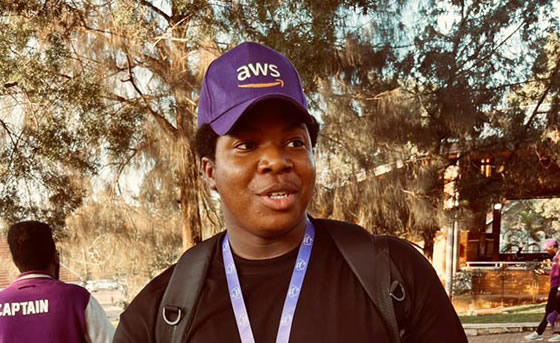
Paul Ifemene Chukwumaobim had never imagined studying beyond his native country, Nigeria. However, the possibility of this happening was introduced to him by his parents, who are missionaries. And Ifemene was supposed to travel close to 3,500km (about 2,175 miles) away from home, to study in Uganda, at Uganda Christian University (UCU).
It was a hard decision to accept, but he eventually did, boarding a plane to Uganda in August 2023.

Although Paul Ifemene initially enjoyed drawing and painting during his early school years, his interest in technology began around 2019 while in secondary school
Born in Anambra State in southeastern Nigeria, but raised mostly in Ebonyi State, Ifemene grew up in a Christian home where education and personal growth were highly valued. His parents played a significant role in shaping his worldview. As the youngest of five children, he learned early about responsibility, faith and the importance of pursuing his goals.
“My parents allowed me to choose what I wanted to study, something not common in many homes.”
Ifemene’s choice was technology.
Although he initially enjoyed drawing and painting during his early school years, his interest in technology began around 2019 while in secondary school. During school holidays, his mother would enroll him for basic computer lessons. What started as simple training in the use of Microsoft Office and internet navigation soon grew into a deeper interest.
“I realized that technology is also creative,” he says. “You can think of an idea and bring it to life. That was exciting for me.”
At UCU, Ifemene had to undergo the Higher Education Certificate (HEC) program. HEC is a one-year, two-semester bridging course designed for Ugandan students who complete A’level but do not obtain the grades required for direct admission to degree or diploma programs and for international students who need to bridge to Ugandan university entry level requirements.
Adjusting to life in Uganda was not without challenges for Ifemene.
“The currency confused me at first,” he recalls. “In Nigeria, the note with the highest value is one thousand naira, but here, I saw a note of fifty thousand shillings!”
Food, language, and cultural differences also required patience and adaptation. But with time, the hospitable environment at UCU helped him settle in.
“The university often supports international students, which made it easier for me to feel at home.”
Ifemene is currently in second year, pursuing a Bachelor of Science in Information Technology. He describes the learning environment at UCU as vibrant and innovative.
“Our department encourages us to go beyond the classroom, for instance, we attend conferences, collaborate on projects and work with real-world technologies.”
One of the most memorable experiences for him was attending a conference in Kigali, Rwanda, where he interacted with researchers, professors, and technology professionals from across Africa.
“That experience made me realize there is so much more to learn.”
Driven by his belief that knowledge should lead to action, he and his colleagues developed a digital platform known as QuickTask, a project designed to connect university students to potential employers offering flexible work opportunities.
“There are many students with useful skills, but they lack opportunities to earn income or gain experience,” Ifemene explains, adding: “yet, companies and individuals often need short-term help for specific tasks. Quick Task connects the two.”
Through the platform, students can take up flexible work opportunities, such as graphic design, marketing, or other tasks during weekends or free hours.
“If a student has skills and some free time, why should they just sit idle?” he asks. “This platform gives them a chance to connect with employers, work, gain experience and support themselves financially.”
Although the platform is still undergoing development and legal processes before its official launch, the team behind QuickTask has already facilitated a few successful connections between students and businesses.
For Ifemene, the project is one of the ways for him to leave a meaningful footprint in Uganda.
“When you come to a country that welcomes you, you should also give something back,” he says. “University should not only be about attending classes and graduating. It should also be about impact.”
Living in Uganda has also reshaped his perspective on culture and humanity, enabling him to discard the many stereotypes he had about some countries since he has had a chance to study with people of different nationalities at UCU.
++++++++++++++++++++++++++++++++++++++++++++++++++
To support UCU programs, students, activities and services, go to www.ugandapartners.org and click on the “donate” button, or contact UCU Partners Executive Director, Mark Bartels, at m.t.bartels@ugandapartners.org.
Also, follow us on X (formerly Twitter), Instagram and Facebook.
Discover more from Uganda Partners
Subscribe to get the latest posts sent to your email.