By Irene Best Nyapendi
The birth of Denis Ruhama Onzima in 1979 was his mother’s answered prayer. Ruhama’s mother who prayed fervently for a child named him Ruhama, meaning: “God has had mercy on me.”
Having been born in a peasant family, Ruhama felt he carried his family’s hopes. There were times he lacked school fees, but he stayed in school, minding less, even if he was repeating a class due to lack of tuition for the next class.
For instance, the Uganda Christian University (UCU) alumnus said he repeated Primary Seven three times, simply because his family could not afford tuition for his secondary education.
“If you don’t want to dig then, stay in school,” he remembers his mother telling him. Since she did not have the money for his school fees, she advised that he remains in school, continuously studying in Primary Seven, in order for him not to lose interest in education.
When he eventually joined secondary school, the situation of school fees challenges became worse. However, owing to his service as a Scripture Union leader and being a good debater in the English Club, the school headmaster allowed Ruhama to remain in school, despite the fees balances.
“Ruhama, from now you will not be sent for fees, you will clear the fees balances when you complete S.4. However, at S4, you must pass in the first grade,” Ruhama remembers the headmaster telling him. A good score by a student in the national examinations is a marketing tool for the school. Indeed, Ruhama was the best student in Senior Four at Anyavu Secondary School.
For A’level, he joined Mvara Secondary School, studying literature, economics and geography. Ruhama had initially wanted to study law, but he did not meet the cut for government sponsorship for the course at Makerere University.
He was instead admitted to Kyambogo University in 2002 for a Bachelor Arts with Education, studying economics and geography. But he never taught, after completing his course in 2006. Instead, Ruhama preferred to work with non-governmental organizations in community development. After two years, in 2007, he joined UCU’s Bishop Tucker School of Theology and Divinity for a Master of Divinity. His enrollment for the course was after deep prayers by his father, a former lay reader in church and cajoling by Bishop Joel Obetia, who knew Ruhama since his childhood.
“When Bishop Joel Obetia talked to me, I told him, ‘The church is poor. I don’t want that life’,” he recalls. But Bishop Obetia, out-reasoned him, saying one cannot transform the church from the outside. Ruhama conceded, graduating in 2009.
At first, he says he was not happy as a cleric. However, he looked for opportunities to understand why and what could be done. This motivated him to pursue a PhD at Stellenbosch University in South Africa, specifically to study how churches could help people’s spiritual and financial needs.
His topic, “Exploring Holistic Transformation Theology in the Anglican Church of Uganda: A case of Three Dioceses,” examined how the Church of Uganda balances spiritual and socio-economic needs.
The research revealed that while the Church of Uganda understands holistic ministry, it often prioritizes spiritual work over physical and economic needs, driving some Anglicans to Pentecostal churches for practical support.
Ruhama wants the Church of Uganda to do more than preach. He recommends locally driven micro-projects, intentional integration of development into church structures and stronger theological education to address the gaps.
“If Christians have wealth, knowing that it is from God, they will use their wealth to help others, and that is ministry,” he explained.
He says he’s sharing his research ideas with church leaders and hopes they will make a difference.
At UCU Arua Campus, he practices what he preaches, encouraging students to grow crops like cabbages, tomatoes and onions to earn a living for the glory of God. He believes that no minister should beg from Christians. Each minister should be an example to the Christians. And that every Christian must create wealth to serve the neighbor.
Ruhama joined UCU in 2014 as the Dean of Students at the Arua campus. After serving as the dean for four years, he transitioned to the Development and External Relations Office, where he focused on fostering partnerships and enhancing the university’s outreach. In 2020, Ruhama then focused on teaching, later becoming the Head of the Theology and Divinity Department.
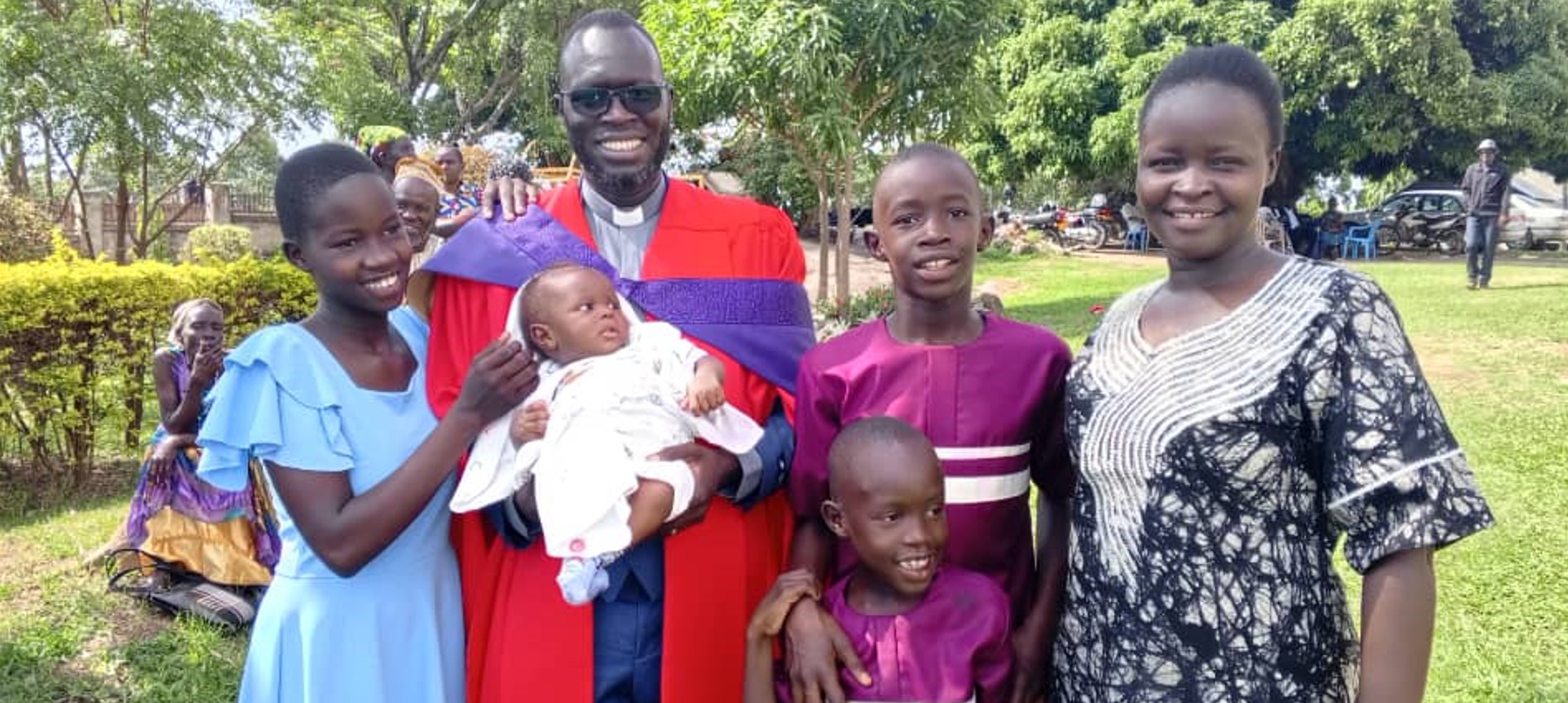
At 45 now, Ruhama’s journey from a village boy to a scholar is a dream come true. As a child, he prayed to get a degree at 25, a master’s by 30, marry after a master’s degree and a PhD by 45. He also dreamed of flying in a plane before 40. He has achieved all those dreams. Ruhama is married to Proscovia Ndaru. The couple has four children – a daughter, Deborah Ruhama Letasi, and three sons – Deogratias Ruhama, Deuel Ruhama Agani and Deshawn Ruhama.
+++++++++++++++++++++++++++++++++++++++++++++++++++++++++++++++
To support Uganda Christian University programs, students, activities and services, go to www.ugandapartners.org and click on the “donate” button, or contact UCU Partners Executive Director, Mark Bartels, at m.t.bartels@ugandapartners.org.
Also, follow us on X (formerly Twitter), Instagram and Facebook
Discover more from Uganda Partners
Subscribe to get the latest posts sent to your email.