By Kefa Senoga
What began as a pastoral outreach by the Uganda Christian University (UCU) Department of Church Relations to the Diocese of Ruwenzori earlier this year has blossomed into a multi-pronged initiative aimed at improving household income, reducing malnutrition and restoring hope among the vulnerable.
According to the Rev. Dr. Robinah Kunihira, the diocesan coordinator for household and community transformation, during the visit to Fort Portal, a city in western Uganda, UCU, through its Church Relations Department, identified several pressing issues. Those issues included food insecurity, increasing cases of prostitution and high HIV prevalence.
“Many of these issues were tied to poverty,” Kunihira said. “Our communities needed economic empowerment and agriculture was agreed on as the obvious starting point.”
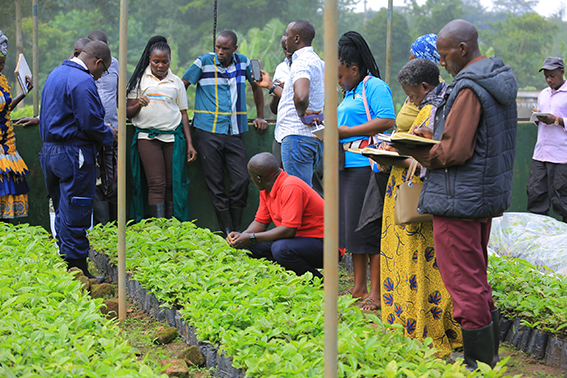
Farmers receiving training on how to set up a nursery bed
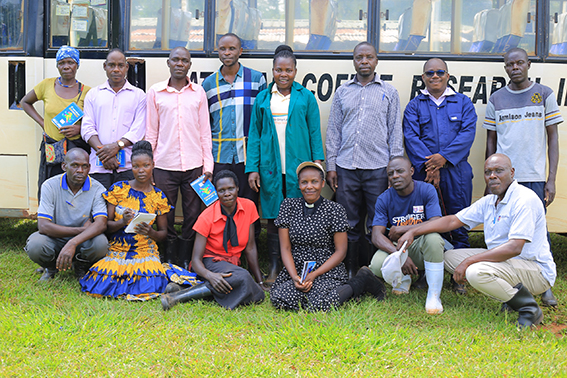
The centerpiece of the intervention is coffee, an industry with both local familiarity and global profitability. In partnership with the National Coffee Resources Research Institute (NaCORI) and supported by UCU Partners (USA), UCU facilitated an intensive training for 13 model farmers from the Ruwenzori Diocese. The aim was to equip the farmers with skills in preparing a coffee nursery bed, grafting, clone cutting and high-yield variety propagation. Those farmers were expected to train others and launch income-generating coffee seedling enterprises within their parishes and archdeaconries.
The training focused not just on production but also on sustainability and scalability.
Such renewed interest in coffee farmers is not surprising. The crop is considered an important commercial crop globally, and the second most traded global commodity by developing nations after oil. Uganda is among the top 10 coffee exporters worldwide, and the second in Africa.
One of the enthusiastic trainees, Kaganda Bbala Barahija, a coffee farmer from Kyenjojo district, said: “I’ve learned practical skills in potting, grafting and clone cutting. This training has deepened my knowledge, and I plan to implement it on my farm and pass it on to others in my district. We’ll grow and distribute modern coffee varieties across our diocese.”
Robert Mwanguhya from Bunyangabu District noted his new found discovery: “Before, we mainly relied on traditional coffee breeds. Now, I know modern varieties are more productive and profitable. I am excited to take this knowledge back to my fellow youth and even explore value addition opportunities.”
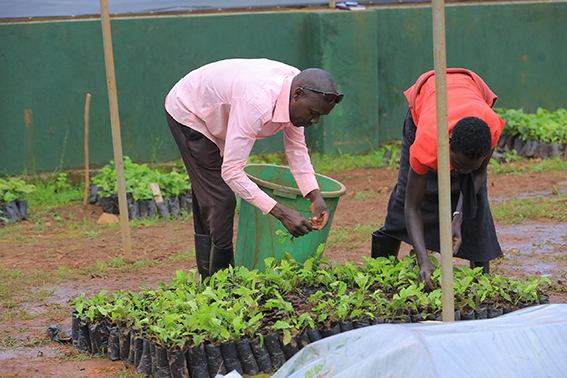
Participants during the training
For Edward Waako, he said the training has helped him gain knowledge in how to set up a nursery bed and nurture the plant until it is fruitful.
Dr. Jonathan Tumwebaze, Manager, Christian University Connections, UCU Partners, who coordinated the project, said the goal is to establish diocesan-level mother gardens.
“The gardens will not only provide quality seedlings at subsidized prices to Christian farmers, but also serve as a sustainable income stream for the diocese itself,” he said. “It’s a model that supports both community development and church growth.”
To ensure expert guidance, Ruwenzori diocese also brought professionals from NaCORI to inspect and approve the future site of a diocesan coffee nursery bed in Kyenjojo District.
Beyond coffee, the partnership has borne other fruits. UCU and the Diocese of Ruwenzori are preparing to launch a skilling and rehabilitation center for former sex workers – part of a broader health and transformation agenda.
“We’ve already seen early results,” Kunihira noted. “From coffee nurseries to plans for vocational rehabilitation, we’re making steps toward holistic community transformation.”
Initiatives like these are a direct answer to what the Rev. Dennis Ruhama Onzima, a UCU alumnus and staff member, has always preached about – pushing for a holistic transformation in the Church of Uganda. It shows how far the church can go to push for wealth creation among its people.
+++++++++++++++++++++++++++++++++++++++++++++++++++++++++++++++
To support Uganda Christian University programs, students, activities and services, go to www.ugandapartners.org and click on the “donate” button, or contact UCU Partners Executive Director, Mark Bartels, at m.t.bartels@ugandapartners.org.
Also, follow us on X (formerly Twitter), Instagram and Facebook
Discover more from Uganda Partners
Subscribe to get the latest posts sent to your email.