By Irene Best Nyapendi
An education partnership that was signed in South Africa last year between Uganda Christian University (UCU) and the Accelerated Education Enterprise (AEE) has started bearing fruits. UCU has become the first university in the world to host a Trainer of Trainers’ Programme for Accelerated Christian Education (ACE) curriculum that is managed by AEE in Africa.
The institution is also poised to be the pioneer university training ACE educators at postgraduate level globally. The UCU School of Education recently concluded a nine-day Training of Trainers workshop, equipping faculty with the skills to implement this Bible-based, holistic education model. The School has also designed a unique Post Graduate Program for ACE educators that is slated for implementation in 2026.
The ACE curriculum, best explained with an acronym for BIBLE (Biblically based, Individualized, Building Godly character, Learner-centered, Excellence-driven), is designed to integrate Christian principles into every aspect of education. Unlike traditional models, ACE emphasizes self-paced learning, character development, and academic mastery.
Facilitators’ training
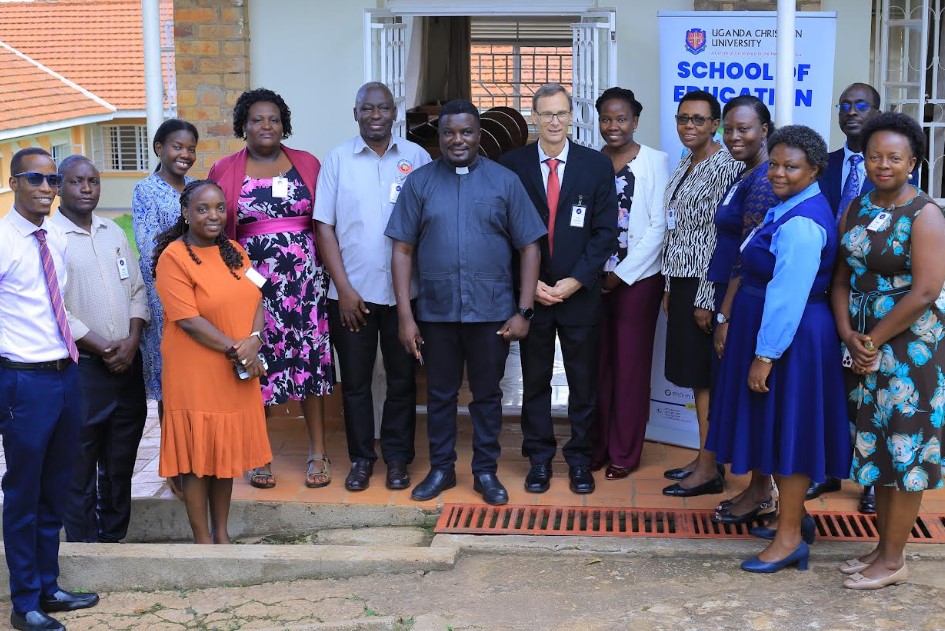
Many UCU staff were trained on the principles and the methodology of the ACE program. At the training, conducted between June 10th and 20th, participants were taken through hands-on activities to enable them to experience the ACE curriculum from a student’s perspective, including scoring their own work and setting daily goals. They also visited Vine International Christian Academy, a model ACE school, on June 19, 2024, where UCU staff observed ACE’s practical application in a school setting. The visit provided insights into how theoretical knowledge translates into real-world teaching practices, emphasizing the curriculum’s effectiveness.
The Deputy Vice Chancellor for Academic Affairs, the Rev. Prof. John Kitayimbwa, who represented the Vice Chancellor at the opening of the UCU ACE training center, commended the UCU School of Education for spearheading the initiative and urged facilitators to implement the curriculum with excellence in order to inspire other institutions.
According to Marius Johannes Bezuidenhout, a Senior Manager at AEE Durban, who traveled from South Africa to lead the training at UCU Mukono, the ACE curriculum’s core principles ensure that students not only excel academically but also grow spiritually and ethically.
Marius, who has been involved with the ACE program for over 30 years, emphasized that ACE’s launch at UCU is not just about academic reform but about fulfilling a biblical mandate. Citing Deuteronomy 6, he stressed the importance of teaching the next generation God’s ways.
“In a world where education often removes God from the curriculum, ACE intentionally places Him at the center of every subject,” he said.
He believes UCU’s adoption of ACE will add synergy to UCU’s focus of producing graduates who are not only academically proficient but also spiritually grounded, ready to impact their communities.
Trainees’ perspective
Evangeline Nalugya, a lecturer at UCU and one of the people who were trained, described ACE as “the best expression of a Christ- and learner-centered curriculum”. She highlighted its focus on both academic competence and character building, noting that it incorporates Christ-like character traits into course content.
“ACE reinforces character development through scripture memory and daily devotions, transforming students’ minds and fostering discipline,” she explained.
Nalugya also emphasized that ACE aligns seamlessly with UCU’s goals as it encourages students to take responsibility for their learning, set personal goals and manage their time effectively. With the training, she said they will now be able to help students enhance character development, promote working independently and time management.
Another trainee, Moses Otuba, also a lecturer at UCU, shared his excitement about applying ACE principles to his classes, even for non-ACE students.
“What stood out was how students train themselves to get the best out of their subjects with minimal support from the teacher,” he said.
He was particularly inspired by ACE’s focus on scripture memorization, goal setting and fostering student-driven learning, which he believes will enhance student outcomes.
Leaders’ take
Assoc. Prof. Angela Napakol, the Director of Academic Affairs at UCU, while officiating the closing of the training, praised the Integrated Christian Learning team for their dedication.
“Change is never easy, as it requires a shift in mindset,” she noted.
Dr. Mary Kagoire, the Dean of UCU’s School of Education, thanked the trainees and trainers for their hard work and for making the time to learn. Announcing that 70% of the needed ACE facilitators had been trained and that they were ready for work, Kagoire added that the ACE program fits perfectly with UCU’s mission to nurture both hearts and minds. She added that the School of Education is making plans to roll out a training program for trainers of the ACE curriculum, with January 2026 as the proposed start time.
This timeline, she says, allows for thorough preparation, including curriculum approval, fee structuring, and resource allocation.
UCU is taking steps to integrate ACE principles across its programs. Faculty are encouraged to adapt course content into PACE (Packets of Accelerated Christian Education) format, transferring learning responsibility to students while embedding biblical values and character traits.
+++++++++++++++++++++++++++++++++++++++++++++++++++++++++++++++
To support Uganda Christian University programs, students, activities and services, go to www.ugandapartners.org and click on the “donate” button, or contact UCU Partners Executive Director, Mark Bartels, at m.t.bartels@ugandapartners.org.
Also, follow us on X (formerly Twitter), Instagram and Facebook
Discover more from Uganda Partners
Subscribe to get the latest posts sent to your email.