By Christine Mirembe
The Uganda Christian University (UCU) School of Law students recently showed that when sharp legal minds meet, it’s not enough to speak. One must speak and command the room.
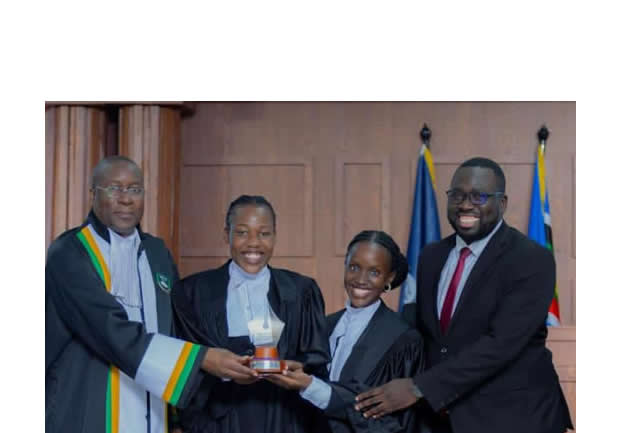
And when they did just that, every stroke of the pen by the judges was in approval of their strong display of advocacy and understanding of laws around data protection and privacy. At the end of the day, their names were etched in the history books as champions of the East Africa Unwanted Witness Privacy Moot Competition, defeating Kenya’s Strathmore University.
The event, which took place on Sept. 24 at the University of Dar es Salaam in Tanzania, was held under the theme, “Safeguarding Personal Data in National Digital ID Systems.” The win guaranteed the team a cash prize of $1,500.

Left to right: Heather Stacy Kutamba and Sandra Ajambo at the Unwanted Witness privacy moot competition in Dar es Salaam, Tanzania.
The UCU team had four ladies: Sandra Ajambo (Year Three, Lead Counsel and Oralist), Heather Stacy Kutamba (Year Three, Oralist), Eunice Nantongo Wangabira (Year Three, Researcher), and Diana Nassuna (Year Three, Researcher).
“We started training early enough,” Kutamba said, letting us into their game plan at the competitions.
“Preparing for a moot is not something that you do last minute; people have a perception that because they have access to the internet, they could prepare for the competition at the last minute,” she said, noting that efforts of a team that has put in months of preparation will be visible in their submissions.
The students did not just gain knowledge to win the top honors. They also took some with them home. From this moot, the team learned about data privacy, individual rights to control how people’s personal information is shared, and the various policies involved therein, such as principles of lawfulness, fairness, transparency and accuracy.
Kutamba acknowledges the difficulty of the topic because it was not something they had covered in law school at the time of the moot, so they had to research and learn everything from scratch.
However, the gifted hands of Joel Basoga, a lecturer at the UCU School of Law, were enough to guide the students. Basoga also is the university’s moot coordinator.
“He devoted so much time for us; he practiced with us right from when the team was set up,” Kutamba said.
Ajambo, who was an oralist, attributes their success to teamwork and effective coordination.
“Preparing for a moot is not easy; we had to put in extra work, just like any other person preparing for a competition,” Ajambo acknowledged.
The journey to the moot competition typically begins at the faculty level, where lecturers recommend law students who perform exceptionally well in moots, a course unit typically completed during the second semester of their second year. The students, alongside those who participate in the annual university moot, are given the opportunity to apply in order to represent the university at the national level.
Following a series of interviews, candidates are presented with a hypothetical case, have it resolved, and then submit their responses before participating in oral interviews. The School of Law then reaches out to successful applicants with details on what is required of them and who they will be working with.
This year’s team secured a win against Islamic University in Uganda (IUIU), hence qualifying to represent Uganda at the regional level. From sleepless nights, pacing between moot practice and law school and consistent prayer sessions, all the sweat they broke finally paid off.
The chief guest, Justice Duncan Gaswaga, a Judge of the African Court on Human and People’s Rights and a Judge of the High Court of Uganda, urged the students to learn an international language, in addition to English.
“As a multi-lingual lawyer, you’ll be able to litigate before international courts and deal with international clients,” he counselled.
UCU is slowly etching its name as a national and regional moot powerhouse. In January, it won the national rounds of the 2025 Philip C. Jessup International Law Moot Court Competition. With that victory, they represented Uganda at the international rounds in Washington, D.C.
+++++++++++++++++++++++++++++++++++++++++++++++++++++++++++++
To support Uganda Christian University programs, students, activities and services, go to www.ugandapartners.org and click on the “donate” button, or contact UCU Partners Executive Director, Mark Bartels, at m.t.bartels@ugandapartners.org.
Discover more from Uganda Partners
Subscribe to get the latest posts sent to your email.